
Internal cooling
Introduction
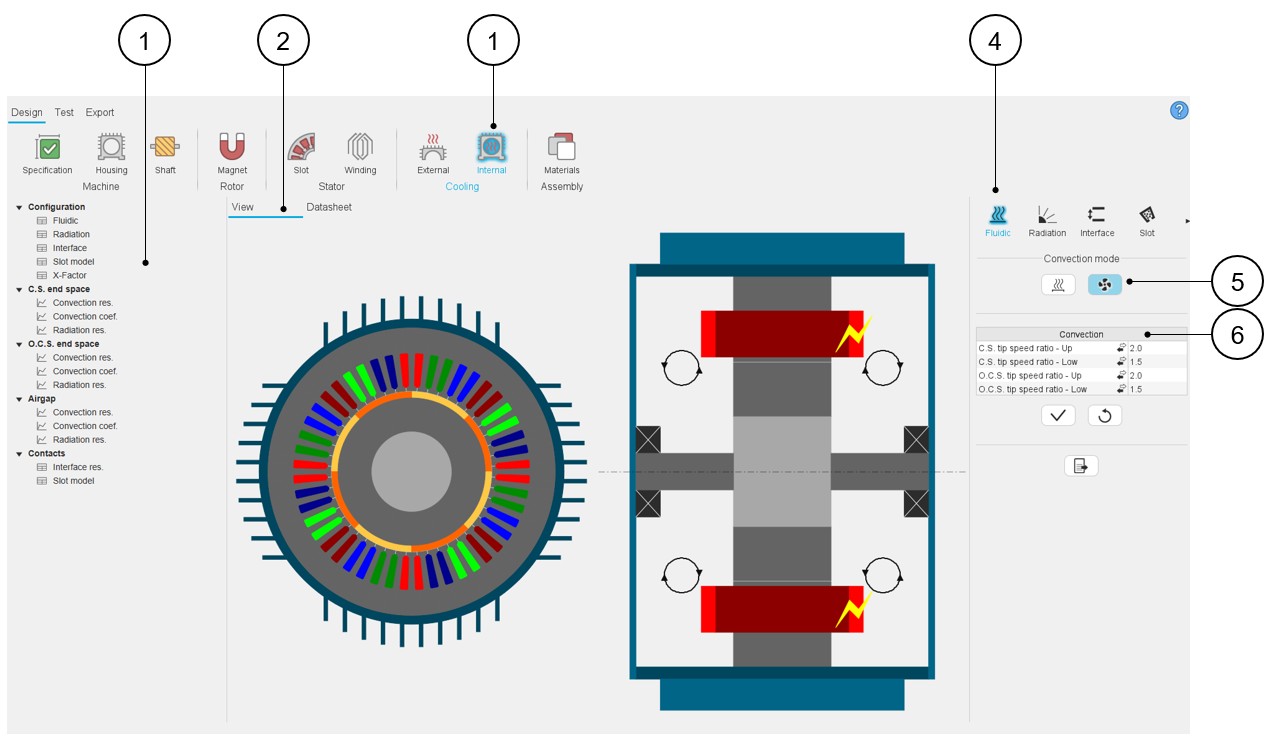
In the Motor Factory – Design area, the environment “Cooling – Internal” allows to define the thermal modeling of the internal cooling, meaning the complex thermal transfers occurring inside the machine.
- The housing can be defined in the Machine subset, Housing panel, and Design settings.
- The shaft can be defined in the Machine subset, Shaft panel, and Design settings.
- Bearings can be defined in the Machine subset, Shaft panel, and Bearing settings.
 |
|
|---|---|
| 1 | Selection of the Cooling subset: Internal panel (Click on the icon Internal). |
| 2 | Once the internal cooling parameters are defined, corresponding results are automatically displayed in the form of a datasheet. Visualization of the internal cooling characteristics (inputs and corresponding results) is possible. |
| 3 | Shortcuts for displaying the corresponding chapter of the internal cooling datasheet. |
| 4 | User inputs: Several sections allow defining all characteristics
that deal with the internal cooling: Fluidic, Radiation, Interface,
Slot, X-Factor. Note: By default, the section
Fluidic is selected. |
| 5 | Choice of the internal convection mode: natural or forced. |
| 6 | Inputs defining the convection (forced or natural, corresponding to the choice above). |
Advice for use
- Hypothesis on fluidic computations
Due to the hypothesis made in fluidic computations, some non-continuity can be observed in the fluid convection coefficient evolution, especially in the airgap and on the frame. These non-linearities and possible non-continuities are related to the change from laminar to turbulent fluid flow.
- Validity domain of the fluidic computations
The fluidic computation embedded in FluxMotor uses analytical laws. For some specific fluid properties, extreme temperatures, and very low forced cooling velocity, the computation can be out of this validity domain.
In such cases, some errors will occur, asking to check the fluid properties and the velocity involved in the forced convection.
For advanced usages not covered by our hypothesis on fluid flow, it is advised to set a “user convection coefficient” manually for these specific regions.
- Natural convection on end windings
When choosing to model that the end spaces are cooled with natural convection, the FluxMotor model uses a quite low rotor tip speed ratio (a value of 5) to describe the fluid velocity far from the rotating components.
This can lead to overestimating the cooling of the end winding for high-speed machines. This model will be improved for future versions.
When a tip speed ratio of 5 seems to overestimate the end winding cooling, it is advised to switch to forced convection mode.
This mode allows forcing some higher tip speed ratios for areas far from the rotor, thus reducing the efficiency of the cooling on the end winding.
- Temperatures considered for fluidic computations
Some fluidic computations are based on two different temperatures: the temperature of the fluid and the temperature of the wall from where the convection occurs.
This explains that the convection results shown in the design environment can be slightly different from the results obtained in the test environment.
In the design environment, the fluid and the wall are at the evaluation temperature, but in the test the wall and the fluid temperatures are evaluated during the solving and are different in most cases.
In future versions these initial estimations in the design environment will be improved; therefore, some changes are expected.
- Interface thickness usage
The temperatures obtained on a machine highly depend on the interface thickness set between each part of the machine. The default interface gap values are set to correspond to classical existing values.
Please, keep in mind that the temperatures seen on a real design will deeply depend on the interface qualities, linked to the quality of the mounting process and the tolerance of these same processes.
Especially for machines with a high density of losses and efficient cooling systems, like water jacket cooled machines, the interface thickness between the frame and the stator yoke is one of the main thermal resistances in t heat extraction. The user must be very careful about the value used for this interface thickness.
The thermal resistances corresponding to the interface thicknesses are computed considering that the interfaces are made of air at 273.15 Kelvin, and at the atmospheric pressure at sea level, this is 1.013E5 Pa.
- Radiation from the shaft
No radiation is considered from the shaft in the FluxMotor model.