
External cooling
Introduction
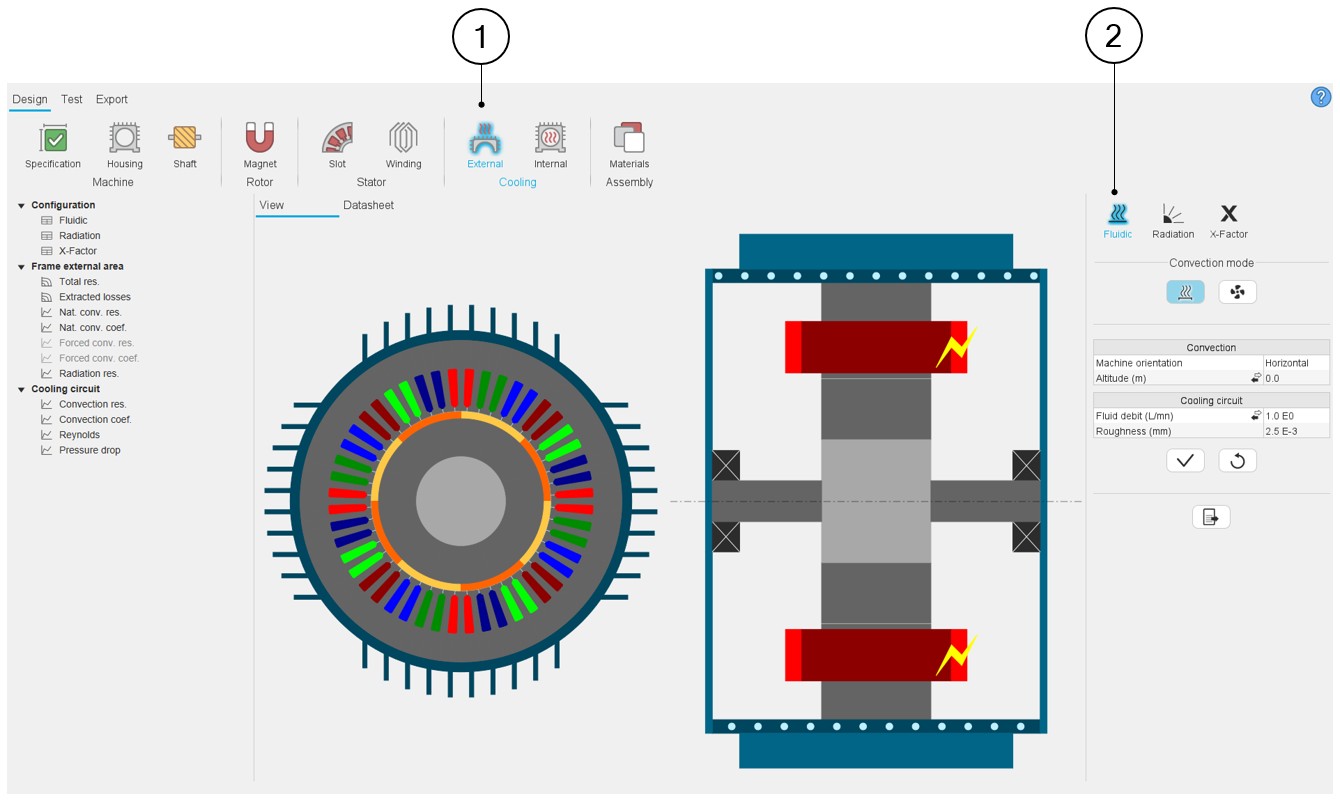
This step allows defining the thermal modeling of the cooling of the external part of the frame.
This area is unlocked only once housing is defined in the Machine subset, Housing design area.
 |
|
|---|---|
| 1 | Selection of the Cooling subset: External panel (Click on the icon External) |
| 2 |
User inputs. Several sections allow defining all characteristics
that deal with the external cooling: Fluidic, Radiation, and
X-Factor.
Note: By default, the section
Fluidic is selected. |
Advice for use
- Hypothesis on fluidic computations
Due to the hypothesis made in fluidic computations, some non-continuity can be observed in the fluid convection coefficient evolution, especially in the airgap and on the frame. These non-linearities and possible non-continuities are related to the change from laminar to turbulent fluid flow.
- Validity domain of the fluidic computations
The fluidic computation embedded in FluxMotor uses analytical laws. For some specific fluid properties, extreme temperatures, and very low forced cooling velocity, the computations made can be out of this validity domain, especially if the fluid experiences a phase transition.
In this case, some errors will occur, asking to check the fluid properties and the velocity involved in the forced convection.
For advanced usages that the hypothesis on fluid flow does not cover, it is advised to set a “user convection coefficient” manually for these specific regions.
- Frame convection and cooling circuit convection
Frame convection and cooling circuit convection are key parameters to understand the thermal behavior of the machine.
FluxMotor provides some internal models to estimate the convection occurring in the cooling circuit and on the frame.
It must be kept in mind that the FluxMotor functions are provided to be used in initial design steps. For advanced uses, it is advised to consider these coefficients carefully and to do additional CFD computation to improve the quality of results.
The FluxMotor model has been validated for machines surrounded by air. The user can select other external fluids, but this goes beyond the validation done on the software.
- Temperature considered for fluidic computations
Some fluidic computations are based on two different temperatures: the temperature of the fluid and the temperature of the wall from where the convection occurs.
This explains that the convection results shown in the design environment can be slightly different from the results obtained in the test environment.
In the design environment, the fluid and the wall are at the same evaluation temperature, but in the test, the wall and the fluid temperatures are evaluated during the solving and are different in most cases.