
/INIVOL
Block Format Keyword For multi-material ALE modeling, this initial condition defines the initial volumetric fractions on a side of a defined surface.
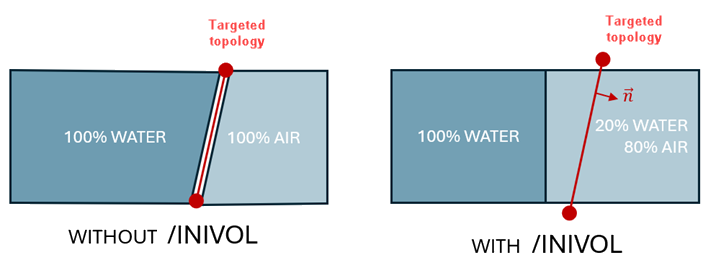
Format
| (1) | (2) | (3) | (4) | (5) | (6) | (7) | (8) | (9) | (10) |
|---|---|---|---|---|---|---|---|---|---|
| /INIVOL/part_ID/inivol_ID | |||||||||
| inivol_title | |||||||||
| surf_ID | ALE_PHASE | FILL_OPT | ICUMU | FILL_RATIO | |||||
| surf_ID | ALE_PHASE | FILL_OPT | ICUMU | FILL_RATIO | |||||
| etc | etc | etc | etc | etc | |||||
| surf_IDn | ALE_PHASE | FILL_OPT | ICUMU | FILL_RATIO | |||||
Definition
| Field | Contents | SI Unit Example |
|---|---|---|
| part_ID | Part of multi-material ALE
elements to be filled. 1 (Integer, maximum 10 digits) |
|
| inivol_ID | Initial volume fraction
identifier. (Integer, maximum 10 digits) |
|
| inivol_title | Initial volume fraction
title. (Character, maximum 100 characters) |
|
| surf_IDn | Surface identifier. 5 (Integer) |
|
| ALE_PHASE | Phase of the
multi-material ALE to fill elements. 3 (Integer) |
|
| FILL_OPT | Reverse normal vectors.
1
(Integer) |
|
| ICUMU | Cumulative filling. 4
(Integer) |
|
| FILL_RATIO | Volumetric Fraction to add
in related elements. 4 0.0 ≤ FILL_RATIO ≤ 1.0 Default = 1.0 (Real) |
Comments
- During Starter execution, the
elements belonging to the PART defined by part_ID are filled with a given volumetric fraction depending on
ALE_PHASE value. The only requirement is that the element
is on the correct side of the given oriented surface. To fill the elements on
the opposite side of the surface normal, use the FILL_OPT
=1. In Figure 2 the green color indicates the side
of the surface which is filled by the /INIVOL option.
Figure 2. FILL_OPT enables the reversal of surface normals allowing the definition of the opposite side to be filled. 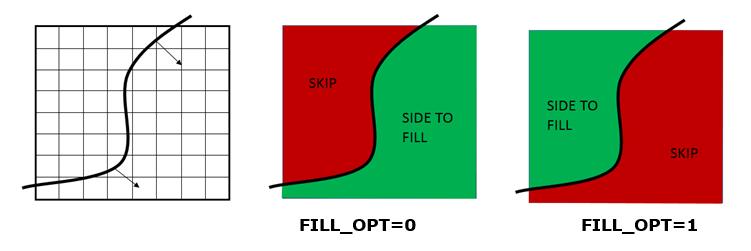
- If an element is crossed by the
surface, then it is not fully on one side. Then a volume estimation is made to
fill only the relevant sub-volume on the related side of the surface.
Figure 3. Element crossed by the surface has 2 sides. INIVOL option considers only relevant portion 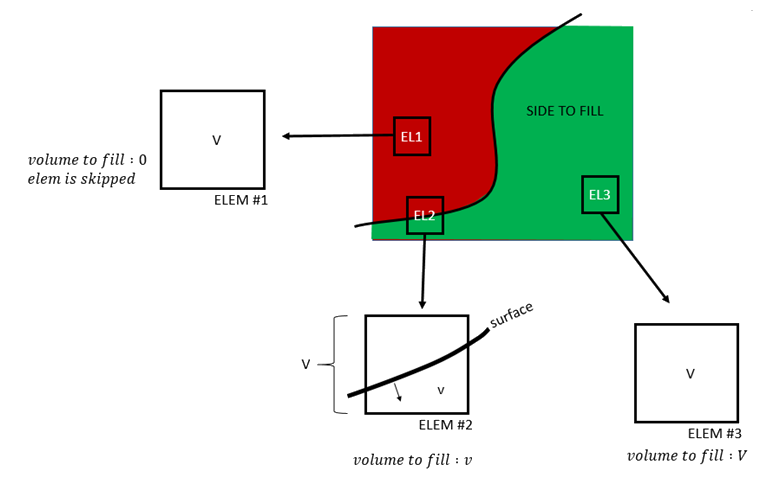
- ALE_PHASE is the multi-material ALE phase ID which is used to fill the given side of the surface. Since /MAT/LAW51 has 4 sub-materials, a value from 1 to 4 must be entered.
- ICUMU flag can
be used to add another material to a volume. For this purpose a
FILL_RATIO must be provided. By default,
ICUMU=0, which means that the existing
volumetric fraction initialized with a previous /INIVOL
process will be erased.
Figure 4. Filling with ICUMU = 0, erase existing filled volumes (default behavior) 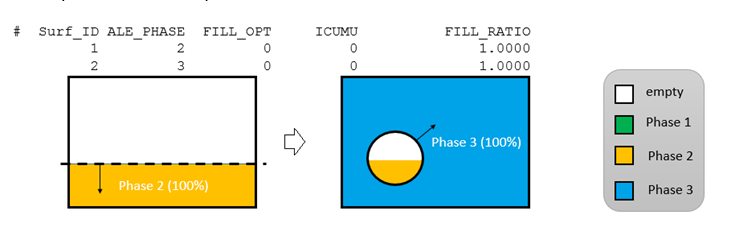
During the 2nd step, the volume outside the disc is filled with the phase 3 material.Figure 5. Filling with ICUMU = 1, volumetric fraction is added into existing filled volumes 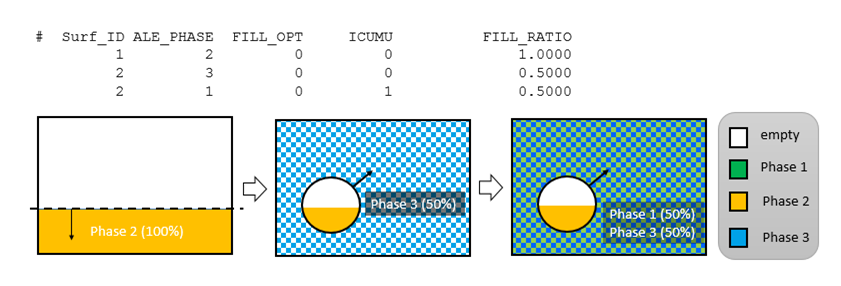
During the 3rd step, the phase 1 material is added to the existing phase 3 material resulting in a 50% mixture of phase 1 and phase 3 material.
ICUMU = -1 is available for 2D only.Figure 6. Filling with ICUMU = -1, volumetric fraction is added into existing filled volumes but existing filling is removed consequently 
During the 2nd step, the phase 2 is already present at 100%. A portion of 50% is removed to make space for the new fraction 2.
If the added fraction leads to a sum of fraction greater than 100%, then the overflow is subtracted from the previous step.Figure 7. 2D filling with ICUMU = -1. Overflow is subtracted from previous step 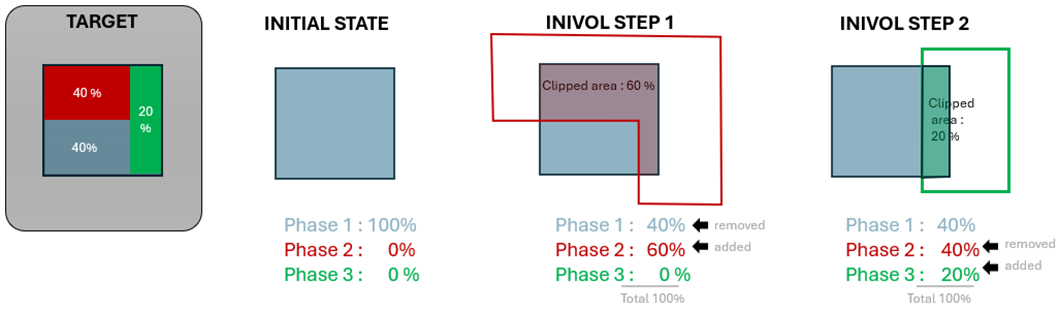
- A well-defined initial condition
for volumetric fraction is such that the volume fraction.
Satisfies:
and
If this condition is not met after all /INIVOL processes, then:- If , volume fractions are scaled so that the sum is equal 1.0.
- If , prevalent default phase (defined from multi-material user definition) 1 is used to fill the remaining unoccupied volume.
Unoccupied sub-volume are automatically filled with phase 1 after all execution of /INIVOL options to ensure that element volume is correctly partitioned.Figure 8. Unoccupied sub-volume are automatically filled with phase 1 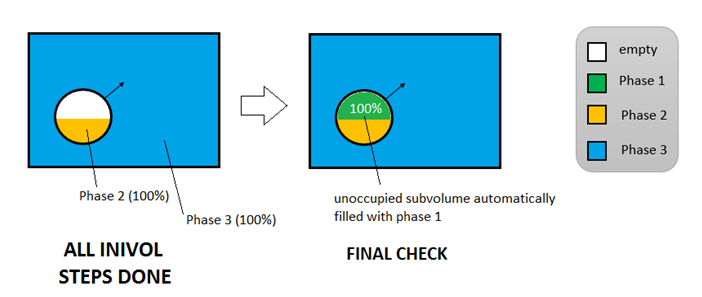
- Supported surfaces are:
- 3-node and 4-node shells. Shell surface (as container) should be fully-closed.
- Infinite plane: /SURF/PLANE or /SET with key PLANE.
- Ellipsoid: /SURF/ELLIPS or /SET with key ELLIPS.
- Segment list: /SURF/SEG or /SET with key SEG.
- Line list: /LINE/SEG or /SET with key SEG only for 2D analysis.
- Sorted nodes list: /GRNOD/NODENS or /SET with key NODENS only for 2D analysis.
Surface can be based on shell elements (/SHELL or /SH3N), void property (/PROP/TYPE0 (VOID)) and on void material law (/MAT/LAW0 (VOID)). This is recommended to avoid any constraining time step calculation for the INIVOL surface because it is only used during the initialization. Otherwise, a rigid body can also be defined for the surface.
- 2D implementation is based on
Weiler-Atherton clipping Algorithm. User surfaces are defining polygons which
are provided with:
- /SUR/SEG, /LINE/SEG: Segments must be correctly ordered and last point of the last segment must match the first point of the first segment to get a polygon (closed surface).
- /GRNOD/NODENS: The closed surface is described by the ordered list of nodes. The surface is automatically closed with the last node and the first node defined in the node set.