
Simulation and Analysis of the GranuHeap Granular Material Heap Analyzer test
This section provides instructions on running an EDEM simulation of the GranuHeap® Granular Material Heap Analyzer developed by GranuTools and computing the standard measurements of the instrument from the simulation data using the GranuHeap calibration kit.
Introduction
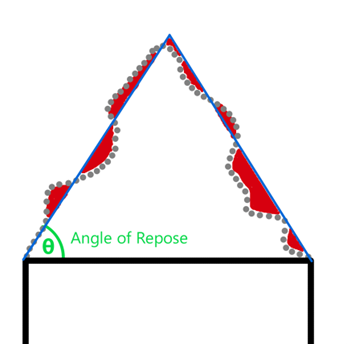
The GranuHeap® methodology is a standardized version of the well-known Angle of Repose (AoR) powder flowability characterization methodology, where, the flow behavior and cohesive properties of granular materials are characterized using the AoR and Static Cohesive Index (SCI) measurements. The AoR is defined as the maximum stable angle of a pile of granular material under static conditions, and the SCI is a measure of the difference between the actual heap shape and an ideal (triangular) heap shape. Both are determined from image analysis. The instrument uses the lifting cylinder method to form the granular pile. A hollow cylinder is placed on a base plate such that there are no gaps and is filled with granular material. The granular heap is then formed by raising the cylinder at a constant rate allowing some of the material to shear off.
- Automated Process - GranuHeap automates the lifting of the cylinder, ensuring a consistent and controlled release of the material, which enhances the repeatability and reliability of the measurements.
- Data Analysis - The AoR and SCI are automatically determined via image analysis and without human intervention.
- Consistent and Repeatable Results - By using a standardized testing methodology, GranuHeap ensures that results are consistent and repeatable.
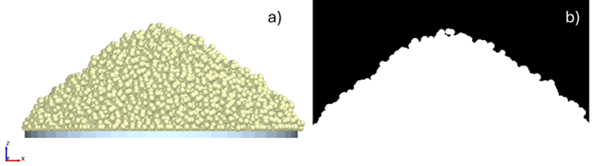
The physical geometry and standard test procedure of GranuHeap are replicated in the providedEDEM simulation deck. A standard test consists of recording side-on images of the granular material under static conditions (after 5 seconds by default) at different angles around the pile as shown in Figure 1.
Prerequisites
All the requisite files are located at: <Altair installation folder>\EDEM <version>\examples\Calibration Kits\GranuHeap.
Using the kit
| Parameter | Description |
|---|---|
| Number of Images (-) | Specifies the number of images taken around the granular pile for the determination of the AoR and CI. The orientation angles are equally spaced between 0 and 180 degrees. The minimum value is 1. |
| Save images? (Yes/No) | Specifies whether the analysis images are retained. If you select Yes, the images are stored in a sub folder within the simulation deck folder. |
| Individual report? (Yes/No) | Specifies whether an individual results report is written out
for every simulation deck. If you select
Yes, a report containing all relevant
results is generated per simulation deck in its corresponding
folder in .csv format. |
| Summary report? (yes/no) | Specifies whether a summary report with the key results for
all simulation decks will be produced. The results are written
out in the Summary.csv file in the Python
script folder. |
The default settings correspond to the standard test procedure of the instrument. A settings text file is required for each folder containing EDEM simulation decks, and the settings are used to post-process all simulation decks in that folder.
The provided Python script can be executed from , or from the command line. To run the script from the command line, you must ensure that EDEMpy is installed in the relevant Python distribution. For more information about installing EDEMpy, see Install EDEMpy.
Acknowledgement
The development of the GranuHeap calibration kit was made during the PhD thesis of Ben Jenkins in the framework of a collaboration between GranuTools and the University of Birmingham under the academic supervision of Dr. Kit Windows-Yule and Prof. Jonathan Seville.