A uniform, homogeneous plate which is symmetric about horizontal axes in both geometry
and loading, to find the maximum axial stress in the plate with a hole.
This means that the state of stress and deformation below a horizontal centerline is a
mirror image of that above the centerline, and likewise for a vertical centerline. You can
take advantage of the symmetry and, by applying the correct boundary conditions, use only a
quarter of the plate for the finite element model to test for non-convergence solution
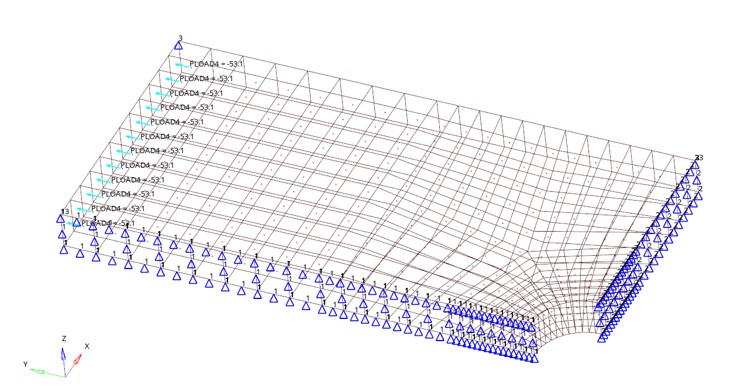
results in OptiStruct.Figure 1. FE Model
Model Files
Before you begin, copy the file(s) used in this example to
your working directory.
Place the origin of X-Y coordinates at the center of the hole. If you pull on both ends of
the plate, points on the centerlines will move along the centerlines but not perpendicular
to them. This indicates the appropriate displacement conditions to use, as shown in Figure 1.
FE Model
Element Types
CHEXA
The linear material properties are:
MAT1 and MATS1
Young’s Modulus
1.5E5 MPa
Poisson's Ratio
0.3
Initial Yield Point
60.5 MPa
Results
Nonlinear iterations do not converge and OptiStruct saves the
last converged solution by default with NLOUT.
To save non-converged solution, NLOUT is specified in the model. The
SVNONCNV parameter on NLOUT entry is set to
YES by default:
SVNONCNV = YES
Saves the last non-converged iteration
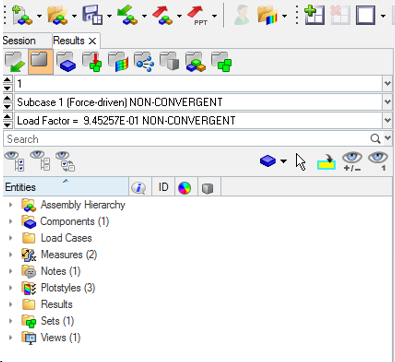
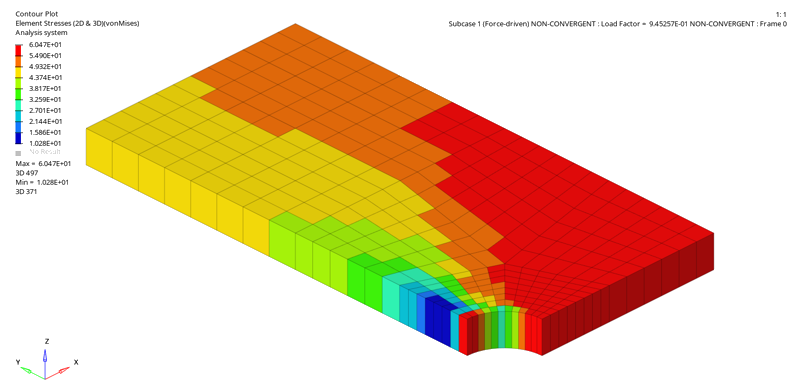
In H3D, it is labeled as NON-CONVERGENT at the final load factor, shown in
Figure 2.Figure 2. Stress Contour