
Impedance
Overview
The aim of this section is to compute the inter-bar impedance of the damper.
In the section on impedance, two solutions are proposed to compute the end-ring
impedance:
- None: Automatic mode.
- Constant: A user mode where it is possible to set the different values of resistance and inductances.
 |
|
|---|---|
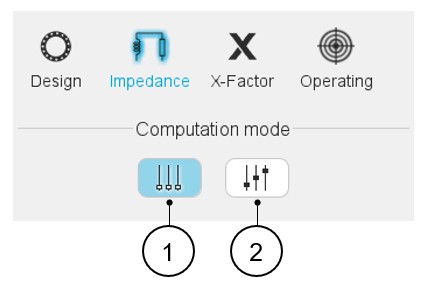
| 1 | Default setting: Automatic way for computing the end-ring impedance. It is based on internal computation processes. |
| 2 | Button to select a user mode for defining the different values of resistance and inductances |
Automatic
When automatic computation mode is set, inter-bar end-ring impedances are computed by internal processes, being a function of the temperature at the end-ring (at Connection Side and Opposite Connection Side), and the material of the end-ring.
Constant computation mode
When constant computation mode is set, the inter-bar end-ring resistance and inductance values must be set by the user. The values are given for a reference temperature. In this case the inter-bar end-ring resistances and inductances depend on the temperature and materials of the end-ring.
 |
|
|---|---|
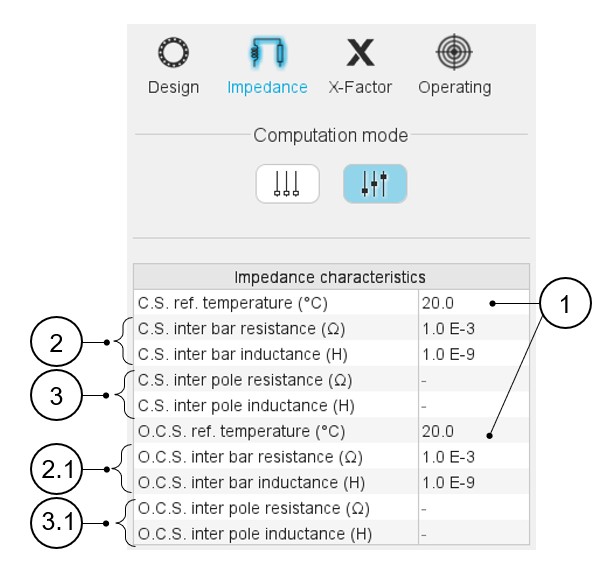
| 1 | Reference temperatures for both sides of the machine |
| 2 - 2.1 | Inter-bar impedance characteristics to be defined on both sides of the machine. |
| 3 - 3.1 | Inter-pole impedance characteristics to be defined on both sides of the machine. |
Note: On one pole, the distances between bars may differ from one
another. In that case one only considers average value in the automatic mode as well
as in user mode (Constant).