
Solver Settings

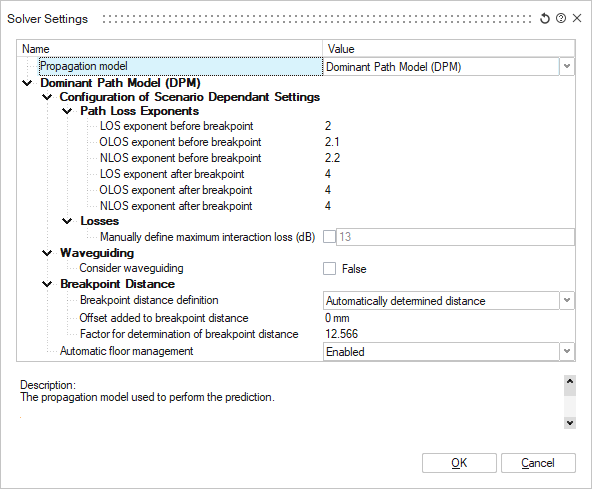
The Solver Settings dialog is used to specify the propagation model used for the simulation as well as settings related to the chosen model.
Dominant Path Model (DPM)
The dominant path model (DPM) determines the dominant path between the transmitter and each receiver pixel. The computation time compared to ray-tracing is significantly reduced and the accuracy is nearly identical to ray-tracing.
Ray-optical propagation models are still very time-consuming – even with accelerations like preprocessing. And what is even more important, they rely on a very accurate vector database. Small errors in the database influence the accuracy of the prediction. On the other hand, empirical models rely on dedicated propagation effects like the over-rooftop propagation (for example the direct ray COST 231). A comparison of prediction results computed with three types of prediction models is presented in the following figure.
Analyzing typical propagation scenarios shows that in most cases one propagation path contributes more than 90% of the total energy. The dominant path model (DPM) determines exactly this dominant path between the transmitter and each receiver pixel. So the computation time compared to ray-tracing is significantly reduced and the accuracy is nearly identical to ray-tracing.
Empirical models (like COST 231) consider only the direct path between a transmitter and a receiver pixel. Ray tracing models (like IRT) determine numerous paths. DPM determines only the most relevant path, which leads to short computation times.
- The dependency on the accuracy of the vector database is reduced (compared to ray-tracing).
- Only the most important propagation path is considered, because this path delivers the main part of the energy.
- No time-consuming preprocessing is required (in contrast to IRT).
- Short computation time.
- Accuracy reaches or exceeds the accuracy of ray-optical models.
As the dominant path model does not require a preprocessing of the vector building database it is ideally suited for very large areas. Additionally the approach to compute only the dominate ray emphasizes this operational area. The model does not compute the complete channel impulse response, thus if the user is interested in the channel impulse response, the delay spread or the angular spread, a ray-tracing model is recommended. The DPM is the ideal approach to compute coverage predictions in large urban areas.
The DPM determines the dominant path between transmitter and each receiver pixel. The computation of the path loss is based on the following equation:
- Distance from transmitter to receiver ( )
- Path loss exponent ( )
- Wave length ( )
- Individual interaction losses due to diffractions ( )
- Empirically determined loss reduction due to wave guiding ( )
- Gain of transmitting antenna ( )
As described above, is length of the path between transmitter and current receiver location. p is the path loss exponent. The value of depends on the current propagation situation. In dense urban areas tends to be slightly higher than in open areas. In addition, depends on the breakpoint distance. After the breakpoint, increased path loss exponents are common due to distortions of the propagating wave. The function yields the loss (in dB) which is caused by diffractions. The diffraction losses are accumulated along one propagation path. Reflections and scattering are included empirically. For the consideration of reflections (and scattering), an empirically determined wave guiding factor is introduced. This wave guiding factor takes into account, that a wave propagating in a long street canyon will be reflected on the walls leading to less attenuation compared to free space. Thus, wave guiding effects can be expressed as an additional gain in dB. The directional gain of the antenna (in direction of the propagation path) is also considered.
Multi-Wall Model (COST 231)
This is an empirical model as described in COST 231 (extended Walfisch-Ikegami-model) which takes into account several parameters out of the vertical building profile for the path loss prediction.
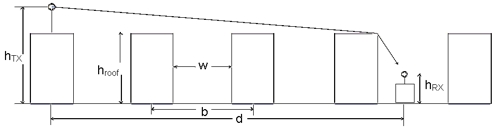
However, their prediction accuracy is limited due to the fact that only a small number of parameters is taken into account and the influence of the distance from the transmitter is over-emphasized. Additionally, wave guiding effects in streets cannot be considered with an empirical approach. The empirical model implemented in SimLab was developed in the course of the European COST 231 project by a combination of the Walfisch and Ikegami models.
- height of transmitter
- height of receiver
- mean value of building heights
- mean value of widths of roads
- mean value of building separation
- road orientation with respect to the direct radio path
However this model is still statistical and not deterministic because only characteristic values are taken into account for the prediction. The model distinguishes between line-of-sight (LOS) and non-line-of-sight (NLOS) situations. In the LOS case – between base station and mobile antenna within a street canyon – a simple propagation loss formula different from free space loss is applied. The calibration of this formula is done by measurements performed in European cities.
The model has also been accepted by the ITU-R and is included in report 567-4. The estimation of path loss agrees rather well with measurements for base station antenna heights above rooftop level. The mean error is in the range of 3 dB and the standard deviation 4-8 dB. However, the prediction error becomes larger for close to compared to situations where . Furthermore the performance of the model is poor for . The parameters and are not considered in a physically meaningful way for micro cells. Therefore, the prediction error for micro cells may be quite large. The model does not consider multipath propagation and as a result wave guiding effects as occurring for example in street canyons are not taken into account. But in situations where the propagation over the rooftops is dominant the model leads to good results.
Because of the calibration with measurements from European cities no parameters have to be adjusted when using this model. However with this empirical approach it is not possible to predict the wideband properties of the mobile radio channel as for example, the delay spread or impulse response.