
Find and Isolate Specific Geometry Types
When performing cleanup or defining simulation parameters, it can be helpful to first find and isolate certain types of geometry. This will give you a better idea of the areas in the model you need to focus on.
-
From the Assembly ribbon, click the Find tool.
Figure 1. 
The Find tool guide bar opens. -
Select a geometry type from the first guide bar
selector.
Figure 2. 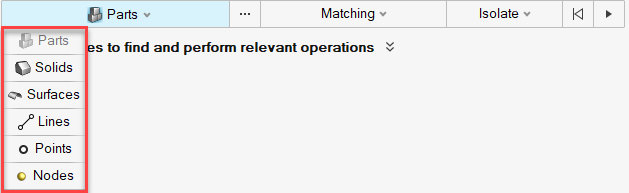
- Optional:
Select specific entities in the modeling window.
If entities are selected, the tool acts upon your selection. If no selection made, it acts upon all displayed entities.
-
Filter by geometry types using the second menu on the guide bar.
Figure 3. 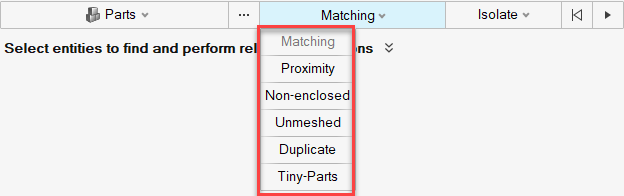
- If necessary, provide a tolerance value, feature angle, etc., to further filter your selection.
-
Select what to do with the found geometry using the third menu.
- Isolate
- Select
- Create group
-
Click
 to run the tool.
The following filtering options are available.
to run the tool.
The following filtering options are available.Entity Type Filtering Option (Geometry Type) Description Parts Matching Identifies parts with identical geometry or topology, often used to detect redundant or mirrored components. Proximity Detects parts that are very close to each other, which may cause meshing issues or unintended fluid interactions. Non-enclosed Flags parts that are not fully enclosed, which can lead to invalid fluid domains or leakage in simulations. Unmeshed Parts that have not been assigned mesh elements, possibly due to geometry errors or exclusions. Duplicates Identifies duplicate parts that may interfere with mesh generation or solver accuracy. Tiny-Parts Small geometric features that are critical for simulation fidelity but may increase computational cost. Solids Connected Checks if solids are properly connected to adjacent geometry, ensuring continuity in the mesh. Slivers Extremely thin regions with high aspect ratios that degrade mesh quality and simulation stability. Intersections Detects overlapping solids that can cause mesh conflicts or solver errors. Self intersections Identifies solids that intersect themselves, often due to modeling errors. Proximities Flags solids that are very close to others, potentially causing mesh refinement or solver instability. Unmeshed Solids lacking mesh elements, possibly due to geometry issues or exclusions. Surfaces Slivers Thin surface regions that result in poor mesh elements and simulation instability. Intersections Surfaces that overlap or intersect with others, leading to mesh errors. Self intersections Surfaces that intersect themselves, often due to CAD modeling issues. Proximities Surfaces that are very close to others, requiring mesh refinement. Unmeshed Surfaces not included in the mesh, possibly due to filtering or errors. Free Surfaces not attached to any volume or boundary, often unintended and problematic. Non-manifolds Surfaces with ambiguous topology, such as shared edges between more than two faces. Sharp Surfaces with acute angles that can cause meshing difficulties; often resolved with filleting. Baffles Thin surfaces used to simulate flow resistance or thermal barriers within fluid domains. High tolerance stitch Surfaces stitched together with high tolerance, potentially masking geometry errors. High curvature Surfaces with tight bends requiring fine mesh resolution to capture flow accurately. Internal Surfaces located inside the fluid domain, often used for internal boundaries or interfaces. Similar Surfaces with similar geometry or topology, used to identify redundancy or symmetry. With intersecting element Surfaces that intersect with mesh elements, causing solver issues. With duplicate element Surfaces sharing identical mesh elements, leading to ambiguity. With proximity element Surfaces near other elements, flagged for potential refinement. With sliver element Surfaces containing sliver mesh elements, which degrade simulation quality. Non Topological Baffle A surface treated as a flow barrier by the solver, without being part of the main mesh topology. Lines, points, nodes Attached Surfaces Identifies surfaces connected to lines, points, or nodes, ensuring proper mesh continuity.
Note: Similar find and isolate functions are also available in the
context menus for surfaces, solids, and parts. These can be accessed either in idle
mode or within another tool.