
Design
Pole topology
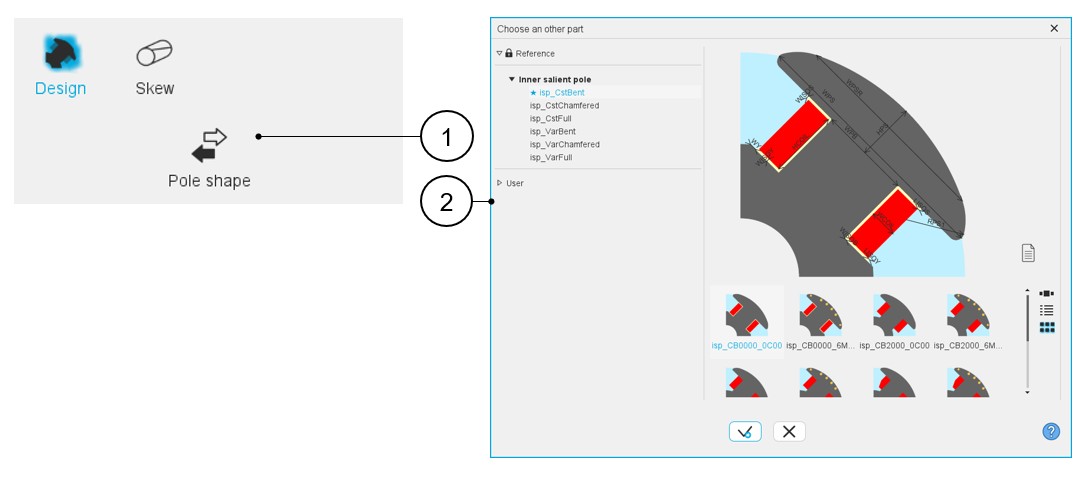
Choosing a new pole topology is possible by clicking on the "Pole shape" button. See the section “Choose part” for additional information. This opens a dialog box, allowing access to the pole libraries.
It allows visualizing, comparing, choosing, and importing another pole topology to modify in the current machine design.
 |
|
|---|---|
| 1 | Pole shape button allows access to the pole libraries to change the pole topology. |
| 2 | Dialog box to visualize and to select the topologies of poles from the pole part libraries. |
Inputs / Outputs
 |
|
|---|---|
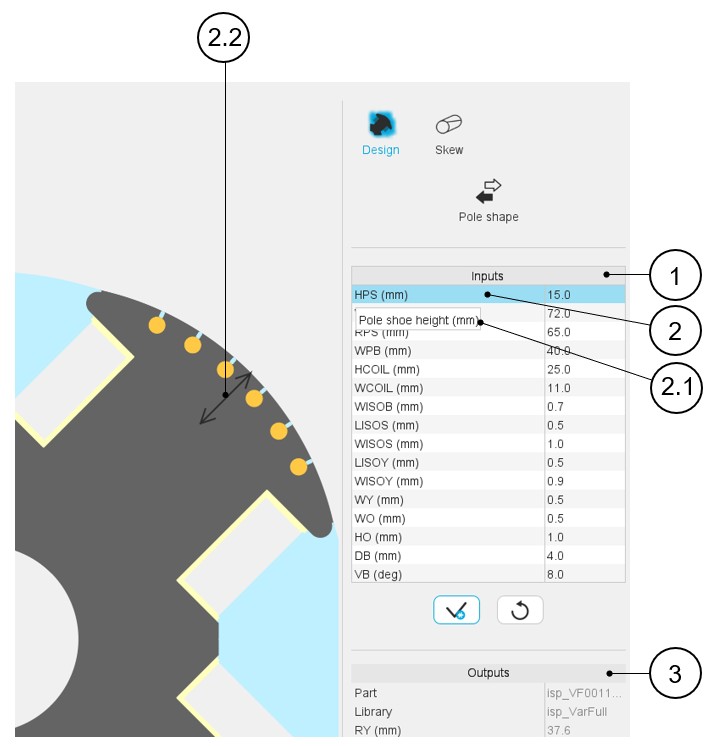
| 1 | User input parameter fields to enter the value. |
| 2 | Selecting a parameter highlights it. |
| 2.1 | Selecting a parameter displays the corresponding tooltip, which completes information about the parameter. |
| 2.2 | Select a parameter label that displays the corresponding arrow on the picture. |
| 3 | Output parameters (read only data) to complete the description of
the topology. Note: The name of the part and
its original library are mentioned in this
section. |
Pole physical properties
- List of possible elementary regions for poles
Here is an example of regions in the inner salient pole.
Table 3. Regions for inner salient pole 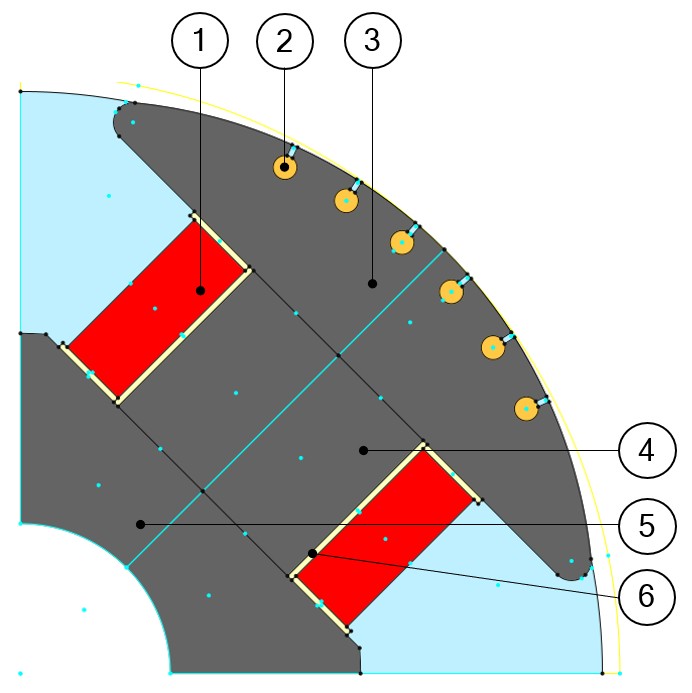
1 Coil conductor 2 Solid Conductor 3 Pole shoe 4 Pole body 5 Yoke 6 Pole insulation Here is the list of possible elementary regions for an inner salient pole:- Coil conductor
- Solid Conductor
- Pole shoe
- Pole body
- Yoke
- Pole insulation
- Mechanical device to represent rivet for example.
- Ferromagnetic wedge
- Hole or Slit
- Cooling hole
- Faces and regions of poles
This section contains a description of all the faces and regions defined and used in the pole model.
Each face is defined by a location point. The coordinates of these points are defined in a general coordinate system.
The point must be within the corresponding face for all the values of user input parameters. Each face has a label and a nature. The nature of faces defines the corresponding regions.
The physical properties of regions are linked to the materials that can be used to build them. The table below gives the physical properties of poles.
Figure 1. Physical properties of pole regions and associated materials 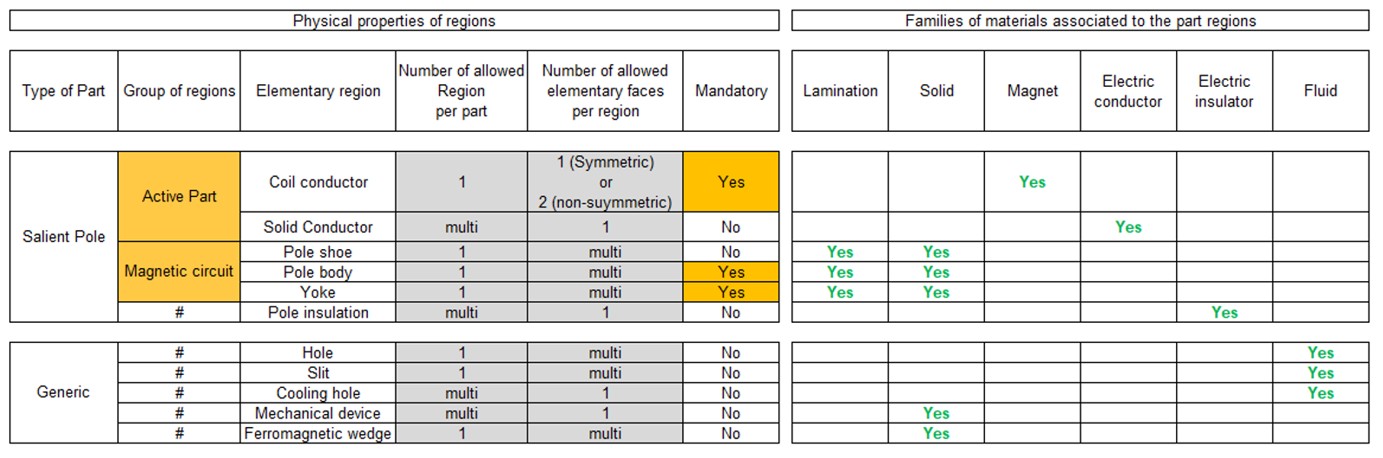
Note: When the regions are grouped (see group of regions above), the same material is associated with all the regions grouped.Note: The possible materials associated with the regions shown above can help users to see the meaning of elementary regions.