Brittle Damage: Reinforced Concrete
Material (LAW24)
The model is a continuum, plasticity-based, damage model for concrete. It assumes that
the main two failure mechanisms are tensile cracking and compressive crushing of the concrete
material.
The material law will enable to formulate the brittle elastic - plastic behavior of the
reinforced concrete.
The input data for concrete are:
E c
Young's modulus
32000 MPa
Vc
Poisson's ratio
0.2
fc
Uniaxial compressive strength
32
fi/fc
Tensile strength ratio
Default = 0.1
fb/fc
Biaxial strength ratio
Default = 1.2
f2/fc
Confined strength ratio
Default = 4.0
s0/fc
Confining stress ratio
Default = 1.25
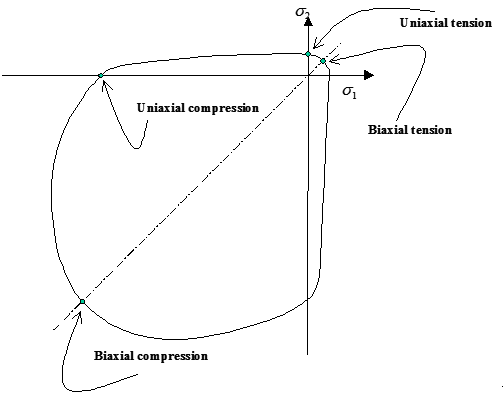
Experimental results enable to determine the material parameters. This can be done by
in-plane unidirectional and bi-axial tests as shown in Figure 2. The expression of the failure
surface is in a general form as:
Where,
Second invariant of stress
Where,
Mean stress
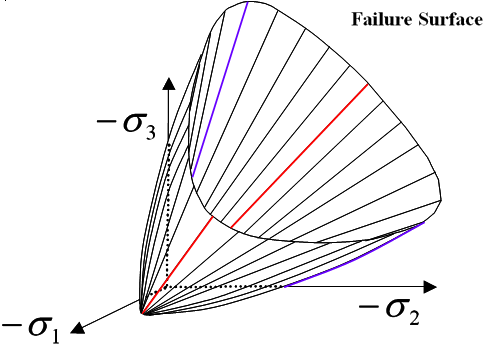
A schematic representation of the failure surface in the principal stress space is given in
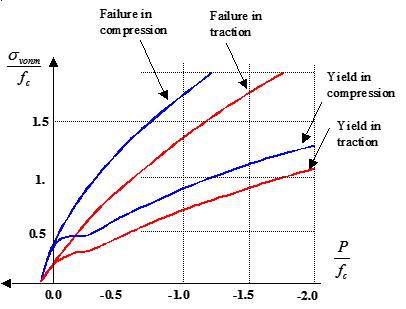
Figure 2. The yield surface is derived from the failure envelope by
introducing a scale factor . The meridian planes are presented in Figure 3.
The steel directions are defined identically to material LAW14 by a TYPE6 property set. If
a property set is not given in the element input data, r, s, are taken respectively as direction 1, 2, 3. For quad elements,
direction 3 is taken as the direction.
Steel data properties are:
Young's modulus
Yield strength
Tangent modulus
Ratio of reinforcement in direction 1
Ratio of reinforcement in direction 2
Ratio of reinforcement in direction 3
Figure 1. Failure Surface in Plane Stress Figure 2. Failure Surface in Principal Stress Space Figure 3. Meridians of Failure and Yield Surfaces