
Hairpin winding
Differences with classical winding
The design of Hairpin winding type meets some limitations compared to the classical
winding:
- Only three-phase winding is considered.
- Only an integer number of slots per pole and per phase are allowed (fractional numbers are forbidden).
- A coil corresponds to one hairpin and not to an association of hairpins and back connections in serial.
- The hairpin, which is associated in serial (thanks to back connections) is called parallel path or elementary coil.
- The number of turns in series per phase is defined by the number of conductors per layer, the number of layers and the number of parallel paths.
- Number of wires in hand is imposed to 1.
- Wire shape can be rectangular only.
- Insulation for conductors and coils is not available (please refer to the definition of coils and conductors).
- End winding shape can be Y shape only.
- New results of quality criteria dedicated to hairpin winding are
available:
- Current balance for parallel paths
- Voltage drops between conductors.
- X-factor section gives access to the inputs of the results, “Conductor voltage drop.”
All these points are described in the following sections.
Design
A scrolling selection bar helps to choose the section in which one can define the winding settings.
Here are the sections available to design the winding step by step:
- “Scheme” to build the winding architecture.
- “Coil” to set how the coil is defined and to see how the slots are filled.
- “Insulation” to define all the winding insulations.
- “End winding” to define the topology and dimensions of the end-windings.
- “X-Factor” to adjust phase resistance and end-winding inductance.
- “Potting” to define the topology and dimensions of the potting around the end-winding.
Note: “Potting” section is available only when the
housing is defined with a frame (circular or square shape).

Note: In the software winding datasheet, the parameters written in
blue correspond to user input parameters and the parameters written in black
correspond to data resulting from computations.
Terminology
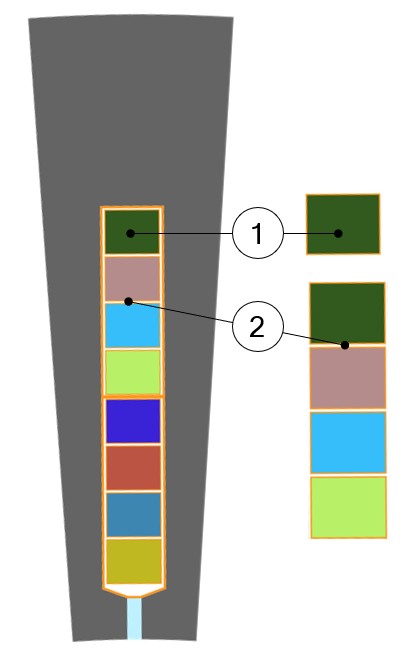
Refer to the section “Terminology – Illustration” dedicated to classical and hairpin winding technology.
 |
|
|---|---|
| 1 | Conductor (also called bundle). That also corresponds to a turn
section (one conductor = one turn). For the hairpin winding type, a conductor is composed of only one wire (one wire in hand). |
| 2 | A coil, which is an assembly of several conductors (i.e. several turns per coil). |
Classical winding outputs
Please refer to the section “Winding / Winding outputs” dedicated to classical and hairpin winding technology.