
X-Factor
Illustrations
 |
|
|---|---|
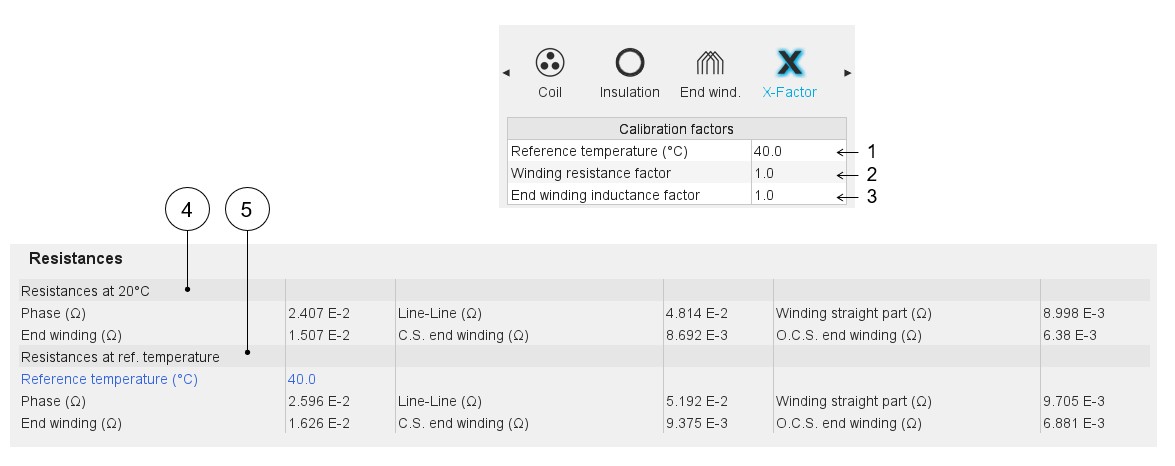
| 1 | The reference temperature: First, resistance values are computed by considering a temperature equal to 20°C (4). However, the users can also define their own reference temperature to compute the corresponding phase resistance and Line-Line resistance values. By default, the reference temperature is equal to 20°C. In our example this value is set to 40°C. |
| 2 | Setting of the “Resistance factor”. It allows adjusting the computation result of resistance. Thus, the resulting phase resistance value is considered. |
| 3 | Setting of the “Inductance factor”. It allows modifying the
computation result of end-winding inductance. Thus, the resulting end-winding inductance value is considered. |
| 4 | Resistance values for a fixed reference temperature equal to 20°C. |
| 5 | Resistance values for the reference temperature chosen by the user. |
Here are a few explanations for this issue:
This issue has been introduced while considering the solid conductors inside the slot. Since the solid conductors are considered, the corresponding resistance (in the straight part of the machine) is deduced from the material properties and the size of the wires.
With X-factor=1, we have (Rphase 0) = (RStraight 0) +(R end winding 0)
- Rphase 0 is the initial value of the phase resistance (with X-Factor = 1)
- RStraight 0 is the initial value of the phase resistance in the straight part of the machine (with X-Factor = 1)
- (R end winding 0) is the initial value of the phase resistance in the straight part of the machine (with X-Factor = 1)
With X-factor≠1, we have (Rphase 1) = (RStraight 1) +(R end winding 1)
- Rphase 1 is the initial value of the phase resistance (with X-Factor ≠1)
- RStraight 1 is the initial value of the phase resistance in the straight part of the machine (with X-Factor ≠1)
- (R end winding 1) is the initial value of the phase resistance in the straight part of the machine (with X-Factor ≠1)
The target is to get the following results:
(Rphase 1) = XFactor x (RStraight 0)
With
(RStraight 1) = (RStraight 0)
This leads to the value for the end winding resistance:
(R end windng 1) = XFactor x (RStraight 0 + R end winding 0) - (RStraight 0)
(R end windng 1) = RStraight 0 x (XFactor - 1) + XFactor x (R end winding 0)
When X-Factor is very low, the end winding resistance can be negative.
We will reconsider how to apply the calibration factor to the winding resistance. Perhaps this will lead to applying the X-Factor only to the end winding and the winding connections, not to the straight part.