
Depuis la version 2026, Flux 3D et Flux PEEC ne sont plus disponibles.
Veuillez utiliser SimLab pour créer un nouveau projet 3D ou pour importer un projet Flux 3D existant.
Veuillez utiliser SimLab pour créer un nouveau projet PEEC (pas possible d'importer un projet Flux PEEC existant).
/!\ La documentation est en cours de mise à jour – des références au 3D peuvent subsister.
Comment créer un ensemble de conditions limites mécaniques ?
Remarque : Le contenu de cette page est en anglais et sera traduit
ultérieurement en français.
To create a set of Mechanical boundary conditions, click the Mechanical boundary conditions node of the Data tree:
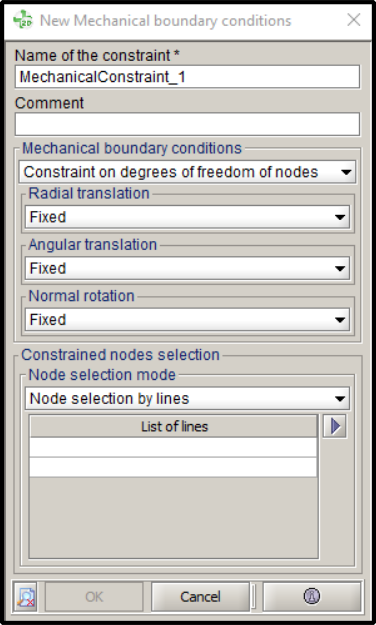
Then, in the New Mechanical boundary conditions dialog box:
- Provide a name for the Mechanical constraint;
- Select an option from the Mechanical boundary conditions drop-down
menu representing the type of boundary condition. Two possibilities are
available:
- Constraint on degrees of freedom of nodes and
- Constraint on node displacement.
- In the case of a Constraint on degrees of freedom of nodes, the user
must inform if the nodal degrees of freedom
- Radial translation,
- Angular translation and
- Normal rotation
- On the other hand, for a Constraint on node displacement, the user
must provide explicit constraint values for:
- the Radial displacement (mm),
- the Angular displacement (mm) and for
- the Rotation (deg).
- Finally, select the mesh nodes that will be subjected to the constraint. Two
Node selection modes are available:
- Node selection by line: applies the mechanical constraint to the mesh nodes lying on geometrical lines. A List of lines must be provided as an input.
- Direct node selection: applies the mechanical constraint to the nodes identified by their numbering in the mesh.