Since version 2026, Flux 3D and Flux PEEC are no longer available.
Please use SimLab to create a new 3D project or to import an existing Flux 3D project.
Please use SimLab to create a new PEEC project (not possible to import an existing Flux PEEC project).
/!\ Documentation updates are in progress – some mentions of 3D may still appear.
Explanation of results
Conduction current and displacement current
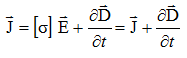
The density of the conduction current is given by the post-processing parameter Jc, which corresponds to the following formula:

The density of the total current (conduction current and displacement current) is given by the post-processing parameter J, which corresponds to the following formula:
Powers: general overview
Contrary to Steady state AC Electric, in Transient Electric, the dielectric losses corresponding to tan (δ) of the material (corresponding also to the hysteresis losses of the D (E) law) are not considered in the computation.
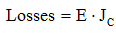
The “losses” term corresponds to the ohmic losses and is equal to the “power” term.
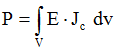
Those two quantities are expressed by the following expressions:
- Instantaneous power:
- Losses:
Electrostatic Energy
The density of electrostatic energy (mean value on one period) on one point is expressed
by the following relation depending on D and E: 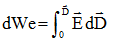
Which can also be written, in linear, homogeneous and isotropic media: 
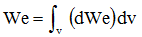
The electrostatic energy (mean value on one period) in a volume region is equal to: