
Since version 2026, Flux 3D and Flux PEEC are no longer available.
Please use SimLab to create a new 3D project or to import an existing Flux 3D project.
Please use SimLab to create a new PEEC project (not possible to import an existing Flux PEEC project).
/!\ Documentation updates are in progress – some mentions of 3D may still appear.
Describing solving conditions
Coupling principle: reminder
The coupling principle is previously described (see § Principle of coupling). In fact, at each time step, a local linking of Thermal and then Steady State AC Magnetic computations is carried out, until the steadiness of the temperature chart is achieved. To carry out this iterative process of thermal updating, you must enter the following information:
- information about the initial temperature chart (at time t0)
- information about the control of the local linking iterative process (stopping criteria)
Chart of the initial temperature
Concerning the chart of the initial temperature, the options proposed with the 2D and 3D solvers are described in chapter Thermal applications: principles.
Control of the iterative process
The control of the iterative process of the thermal updating includes two stopping criteria:
-
a stopping criterion on the steadiness of the temperature chart:
This criterion defines the precision
 of the updating process: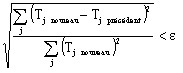
where T is the temperature and j is the node number
-
a stopping criterion on the maximum number of iterations:
This criterion sets the maximal number of iterations ; it allows stopping of the solving process in case of non convergence of the thermal updating process.