Depuis la version 2026, Flux 3D et Flux PEEC ne sont plus disponibles.
Veuillez utiliser SimLab pour créer un nouveau projet 3D ou pour importer un projet Flux 3D existant.
Veuillez utiliser SimLab pour créer un nouveau projet PEEC (pas possible d'importer un projet Flux PEEC existant).
/!\ La documentation est en cours de mise à jour – des références au 3D peuvent subsister.
Optimisation topologique : Exemple
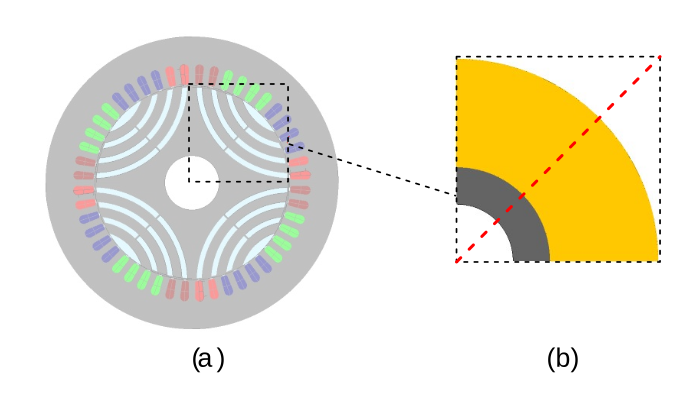
With the topology optimization tools available in Flux 2D, it is now possible to obtain a rotor design that satisfies a set of specifications using only a rough initial design. In this example, the initial shape is simply a hollow solid cylinder, as shown in Figure 1.
The desired performance specifications need to be translated into a topology optimization problem that tries to maximize the torque of the machine, while satisfying certain constraints. These are summarized in Table 1 below:
| Objective or Constraint | Response or Constraint type | Definition |
| Objective | Torque | Maximize |
| Constraint | Von Mises stress | Lower than 260 MPa (i.e., 80% of the yield stress value of the electric steel M330_35A used in the rotor) |
| Constraint | Volume | Lower than 80% of the initial design volume |
| Constraint | Symmetry | 45 degrees symmetry (i.e., with respect to the red dotted line shown in Figure 1). |
The topology optimization has been executed on the yellow face shown in Figure 1 using the LevelSet method. A Mechanical problem has also been added to the description in this case to further constrain the topology optimization procedure.
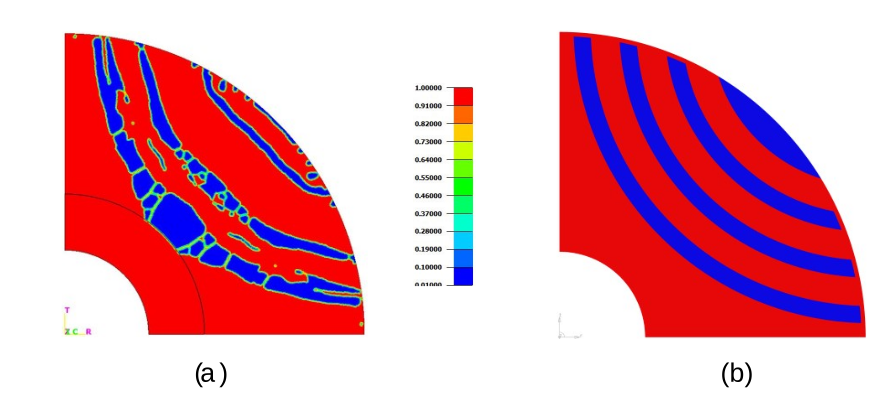
Figure 2a shows the final design obtained after convergence of the topology optimization procedure and compares it to the rotor geometry of a reference machine (Figure 2b). The resulting geometry is quite similar to the reference, showing that the topology optimization techniques may be used efficiently in the conception of rotating electrical machinery.