
Since version 2026, Flux 3D and Flux PEEC are no longer available.
Please use SimLab to create a new 3D project or to import an existing Flux 3D project.
Please use SimLab to create a new PEEC project (not possible to import an existing Flux PEEC project).
/!\ Documentation updates are in progress – some mentions of 3D may still appear.
Re-meshing techniques
Introduction
The displacement of the moving part determines the modification of the geometry of the modeled device. Consequently, the computation domain must be re-meshed at each time step.
In fact, the re-meshing is necessary if there is an air area (known as compressible) between the fixed part and the moving part. If the parts slip one compared to the other (and if there is no air area between the two), the re-meshing is not necessary.
The different techniques of motion treatment (from a geometry and mesh point of view) are presented summarily in this paragraph and are detailed in the following paragraphs.
Motion
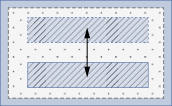
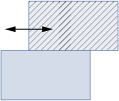
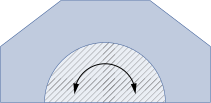
The different situations are gathered in the table below.
| Displacement in a compressible air area | ||
|---|---|---|
| Translation | Rotation | Technique |
 |
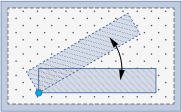 |
separation of fixed / mobile and compressible part re-meshing of the compressible area non-conforming mesh authorized at the level of the dissociation surfaces |
| Sliding motion along a sliding surface | ||
|---|---|---|
| Translation | Rotation | Technique |
 |
|
separation of fixed and mobile part non-conforming mesh authorized at the level of the sliding surfaces |