
Since version 2026, Flux 3D and Flux PEEC are no longer available.
Please use SimLab to create a new 3D project or to import an existing Flux 3D project.
Please use SimLab to create a new PEEC project (not possible to import an existing Flux PEEC project).
/!\ Documentation updates are in progress – some mentions of 3D may still appear.
Transient Magnetic: solved equations (vector model 2D)
Introduction
The vector model is the general model proposed for a 2D application.
Equation solved with vector model (2D applications)
The Maxwell-Faraday equation 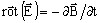 implies
presence of electric scalar potential V, such as:
implies
presence of electric scalar potential V, such as:
The equation solved by the finite elements method in a Transient Magnetic application is written:
where:
- ν0 is the tensor of the relative reluctivity of the medium
- ν0 is the reluctivity of the vacuum; ν0 = 1/μ0 = 1/(4 π 10-7) (in m/H)
-
 is the vector potential (in Wb/m)
 -
 is the coercive magnetic field (permanent magnets)
(in A/m)
is the coercive magnetic field (permanent magnets)
(in A/m)
- σ is the tensor of the conductivity of the medium (in S)
- V is the electric scalar potential (in V)
State variables, vector model (2D)
The state variables are:
- the
magnetic vector potential

- the electric scalar potential V
The state variables, dependent on the problem type, plane 2D or axisymmetric 2D, are given in the table below.
| Type of the problem | State variable |
Notation (in Flux 3D) |
|---|---|---|
| plane | An | AN1* |
| axisymmetric | r⋅An | RAN1* |