
Since version 2026, Flux 3D and Flux PEEC are no longer available.
Please use SimLab to create a new 3D project or to import an existing Flux 3D project.
Please use SimLab to create a new PEEC project (not possible to import an existing Flux PEEC project).
/!\ Documentation updates are in progress – some mentions of 3D may still appear.
SM coupled with TT application: presentation and typical example
Presentation
The Steady State AC Magnetic coupled with Transient Thermal application allows the study of the evolution of electromagnetic and thermal phenomena during the induction heating process of a part.
General operation
This type of study is a coupling between two different applications, one for the evaluation of the electromagnetic field distribution, and the other computing the transient heating of the part as a result of induced power and of thermal transfer:
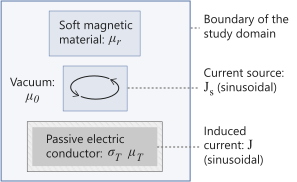
- the Steady State AC Magnetic application allows the computation of the power dissipated by Joule effect into the part to be heated (1)
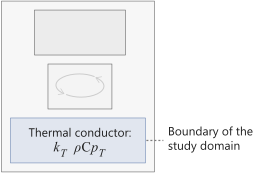
- the Transient Thermal application (2) allows the study of the temperature evolution of the heated part
The power dissipated by Joule effect, computed by the magnetic problemapplication 1, is the source of the thermal problemapplication 2.
Important results
The important results obtainable with the Steady State AC Magnetic coupled with Transient Thermal application are those that can be obtained separately with each of the two coupled applications, i.e. with:
-
the Steady State AC Magnetic application (see chapter Steady State AC Magnetic application: principles)
-
the Transient Thermal application (see chapter Thermal applications: principles)
Typical example
A typical example of a problem treated as a Steady State AC Magnetic coupled with Transient Thermal application is depicted in the figure below.
|
Steady State AC Magnetic Application |
⇒ |
Transient Thermal Application |
|---|---|---|
 |
Induced power = Heating source |
|