
Tutorial: Gravity Tilt Pouring Casting
Tutorial Level: Beginner Step through setup and defining the rotation for a gravity tilt pouring casting simulation.
Import Geometry
- From the menu bar, select .
-
Browse to your working directory, select Tilt-Pour.x_b,
and click Open.
The model opens in the modeling window.
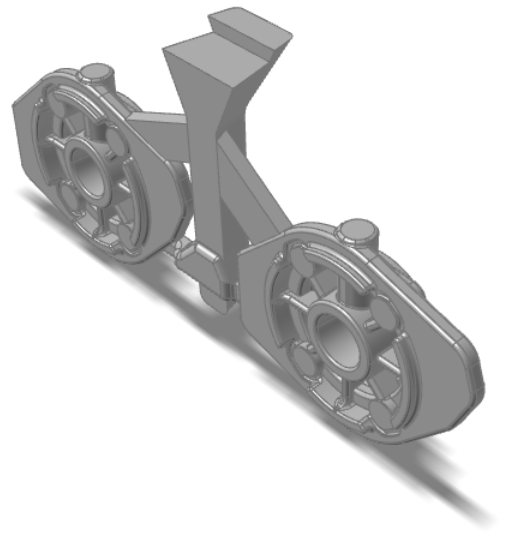
Designate a Casting Part
Select casting geometries with the Cast Part tool.
Important: A cast part must be defined before performing any other
operation.
-
On the Cast Part icon, click Designate
Casting Part.

-
Left-click to select which candidate is a cast part.
Parts are automatically detected and highlighted based on your cursor position.The selected part is highlighted red.

-
In the microdialog, select
Aluminum as the material,
AC-42100 as the alloy, and enter 718 C as the initial
temperature for the part.

- Right-click and mouse through the check mark to exit, or double-right-click.
Set Gravity Direction
-
On the Cast Part tool, click Set Gravity
Direction.

-
Confirm that the part is correctly aligned with gravity.

- Right-click and mouse through the check mark to exit, or double-right-click.
Set the Ingate
-
On the the Gate icon, click Designate
Surfaces as Gates.

-
Select a surface to generate a gate.

- Thre is no need to check any of the checkboxes in the microdialog. Leave them unchecked.
- Right-click and mouse through the check mark to exit, or double-right-click.
Add a Mold
-
Click the Components tool.

Click the Add/Edit Mold tool in the secondary tool group.

-
Select 12343 for the material and enter 150 C for the
initial temperature.

- Right-click and mouse through the check mark to exit, or double-right-click.
Define Process Parameters
-
Click the
 icon next
to the Basic Setup icon, then select the
Gravity icon.
icon next
to the Basic Setup icon, then select the
Gravity icon.
-
Select Filling Time and enter 10
s.

-
Select Tilt Pouring. In the microdialog, use the
Move Rotation Axis tool to change the rotation axis
from global X to global Y. Change the angle of rotation to 90 degrees and change
the rotation time to 4 seconds.

Run Analysis
-
On the Analysis icon, click Run
Analysis.

-
Use the default values for Average Thickness and
Element size.

- Select Run a filling analysis and Run a solidification analysis.
-
Click Run.
Note: Once the simulation calculation is finished, the green flag will appear on the analyze icon.

Note: The user can also select the results by clicking View Now under Run History.
Analyze Results
-
Click Filling under Stage.

-
Click Temperature under Result
Types.

-
Click the Play button on the video controls to start the
animation.

The part fills smoothly and uniformly with no temperature problems.

-
Click Solidification under Stage.

-
Click Porosity under Result
Types.

We can see that the location of the defect is in the filling system and not in the part itself.
