
Since version 2026, Flux 3D and Flux PEEC are no longer available.
Please use SimLab to create a new 3D project or to import an existing Flux 3D project.
Please use SimLab to create a new PEEC project (not possible to import an existing Flux PEEC project).
/!\ Documentation updates are in progress – some mentions of 3D may still appear.
Energies and powers (electric system)
Introduction
This section deals with the stored energy and the power dissipated in an electric system.
Power: definition (reminder)
The instantaneous power consumed by a system with respect to two terminals (dipole) is equal to the product of the instantaneous values of the current I which passes through it and the voltage U at its terminals, respectively:
P=U.I
Stored energy
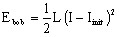
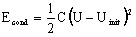
The components that allow the storage of energy are the coils and the capacitors. The energy storage can be a temporary given that the stored energy can be then transferred via a current to the circuit that contains the component.
| Component | Stored energy |
|---|---|
|
A coil of inductance L stores energy as magnetic energy. |
|
| A capacitor of capacitance C stores energy as electric energy. |
|
Dissipated power / Power losses by Joule effect
The components that dissipate energy are the resistive electric components (resistor / brush-segment / switch / diode).
P=U.I=R.I2