
Altair Multiscale Designer 2026 Release Notes
New Features
- Multiscale Material MATMDS is supported in OptiStruct Explicit
- OptiStruct 2026.0 supports Multiscale Designer materials as MATMDS, using the same input format as OptiStruct implicit analysis. This new feature enables the usage of all Multiscale Designer single and Multiscale materials with OptiStruct explicit analysis.
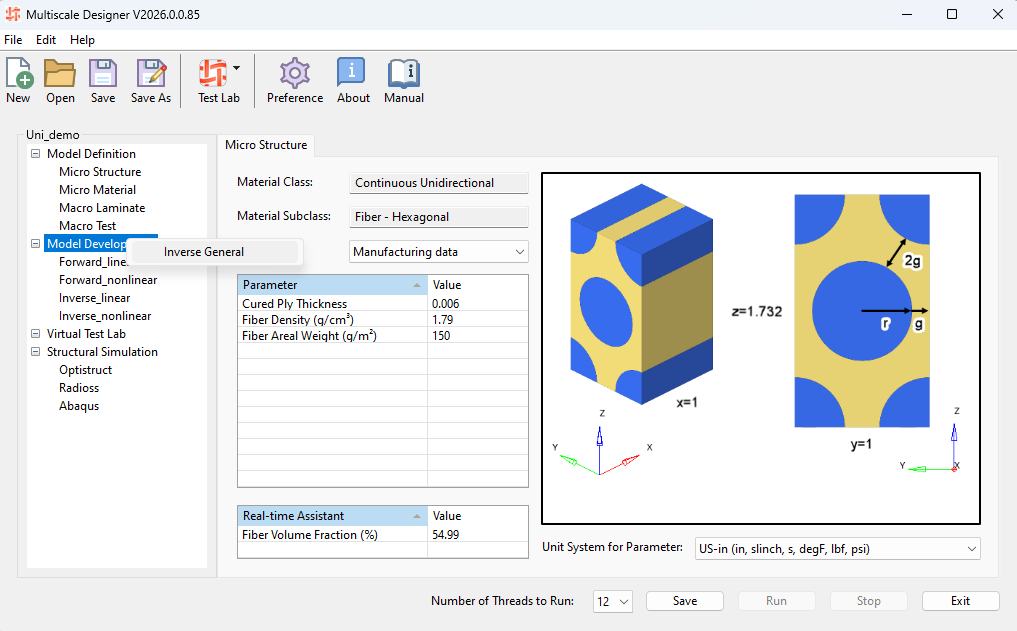
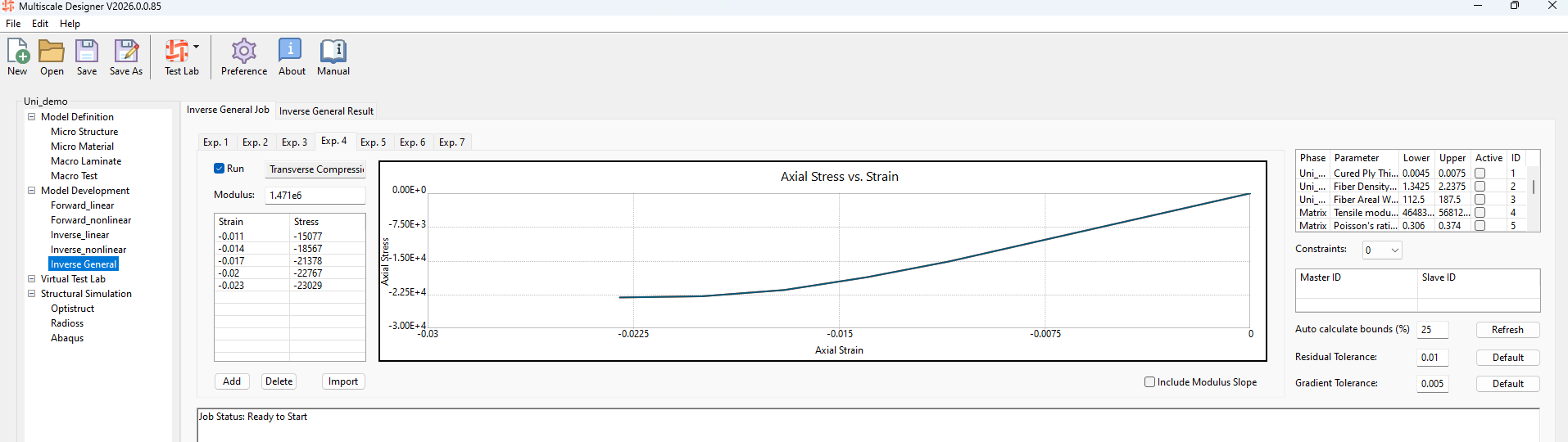
- Inverse General Approach available in all Material Templates
- In addition to the specific inverse methods in the continuous reinforced
and discontinuous reinforced material template, the general inverse
method can be selected enabling the choice of optimizing any material
parameter against test data. While the specific inverse method is the
most efficient to use for any standard combination of matrix and fiber,
the general inverse approach provides the freedom to define an inverse
characterization fitting better for example to non-standard matrix fiber
combination.
Enhancements
- Fiber Orientation Tensor Handling
- The handling of Fiber Orientation Tensors (FOT) is enhanced to a full 3D approach. This enhancement improves the handling of the out of plane fibers and ensures that a 3D Random FOT ( a11 = a22 =a33 = 0.333 ) is leading to a 3D quasi-isotropic homogenized stiffness ( E1=E2=E3 ) in opposite to the prior approach. While the results with that approach will be more accurate, existing material models will provide different results with version 2026.0. More details on the method can be found in the User Manual.
Resolved Issues
- In the inverse general and inverse combined approach, an approximate modulus
is computed when importing strain-stress data.
Figure 1. 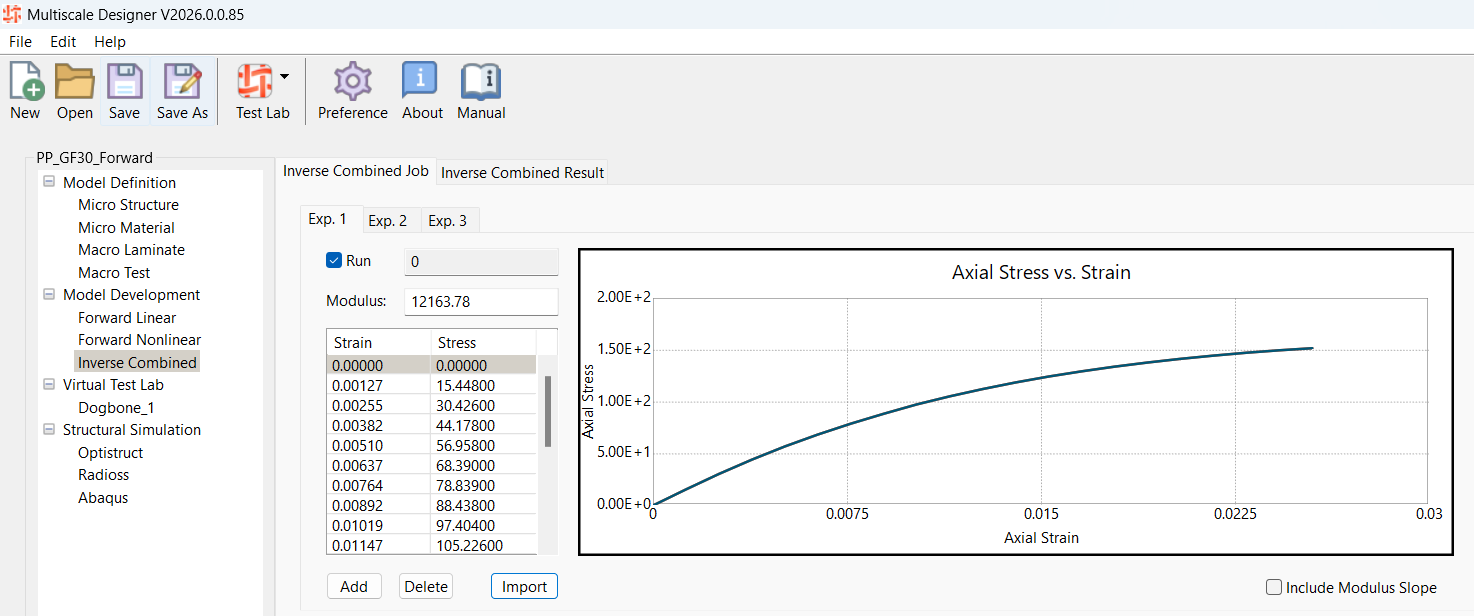
- Similar file names of the virtual tests lead to an error displaying the result.