
Winding
Introduction
This kind of winding architecture is used to build the rotor poles of the wound field synchronous machines.
The rotor field winding has a lot of similarities with the 3-phase winding. Therefore, in each sub-section of the Rotor Winding context, only the differences compared to the 3-phase winding are mentioned. For further information regarding basic knowledge and terminology about electrical winding, please refer to the user help guide: “Windings” which is dedicated to the winding design-general user information.
Design
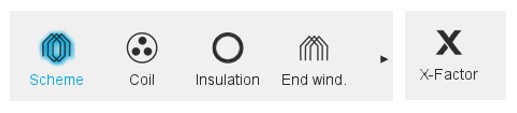
A scrolling selection bar helps to choose the section in which one can define the winding settings.
- “Scheme” to build the winding architecture.
- “Coil” to set how the coil is defined and to see how the pole is wound.
- “Insulation” to define all the winding insulations.
- “End winding” to define the dimensions of the end-windings.
- “X-Factor” to adjust phase resistance and end-winding inductance.
Terminology
Refer to the section “Terminology – Illustration”.
Classical winding outputs
Please refer to the section “Winding / Winding outputs”.
Subsections
Scheme
For more details, please refer to Scheme.
Coil
For more details, please refer to Coil.
Insulation
For more details, please refer to Insulation.
End winding
For more details, please refer to End winding.
X-Factor
For more details, please refer to X-Factor.