
Depuis la version 2026, Flux 3D et Flux PEEC ne sont plus disponibles.
Veuillez utiliser SimLab pour créer un nouveau projet 3D ou pour importer un projet Flux 3D existant.
Veuillez utiliser SimLab pour créer un nouveau projet PEEC (pas possible d'importer un projet Flux PEEC existant).
/!\ La documentation est en cours de mise à jour – des références au 3D peuvent subsister.
Flux dans SimLab : Exemples PEEC
Tutoriels pour les solutions utilisant le solver MIPSE.
Liste des exemples SimLab utilisant :
- la solution Parasitics Extraction
- la solution AC Supplied Conductors
- la solution Magnetostatic Integral Method
Remarque : Le solveur utilisé est MIPSE
Exemples PE
| Solution | Exemple | Description | Illustration |
|---|---|---|---|
| Parasitics Extraction | Power Module | The studied device is a power electronic module component. The entire module is assumed to be made of conducting material and the goal is to compute the Z and S parameter. | 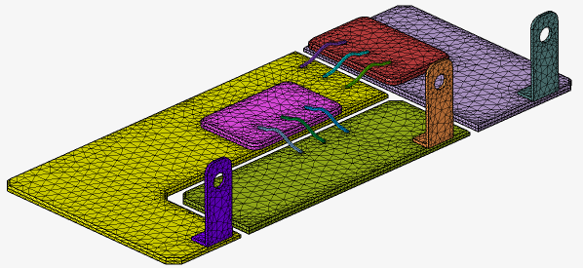 |
| Parasitics Extraction | PE - MOSFET current sharing including busbar parasitic effects | This study deals with a busbar modeling to simulate MOSFET Current Sharing using SimLab to extract S-Parameters, and then use S-Param block in PSIM to compute the currents. |  |
| Parasitics Extraction | PE - Loop Inductance Half Bridge | This study case computes loop inductance for dual-side ground-return routing using Impedance computation from 1 Hz to 100 kHz. |  |
Exemples SCAC
| Solution | Exemple | Description | Illustration |
|---|---|---|---|
| AC Supplied Conductors | Busbar | The device studied is a busbar. It is a copper device and the purpose is to calculate the joule losses in the geometry, and the electric current in the RL loads. | 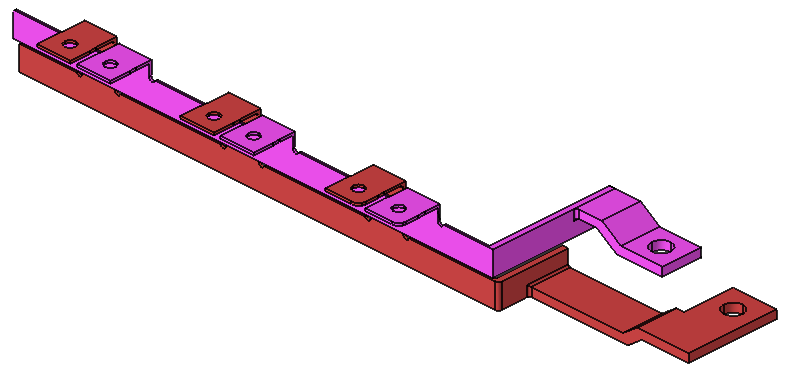 |
Exemples MSIM
| Solution | Exemple | Description | Illustration |
|---|---|---|---|
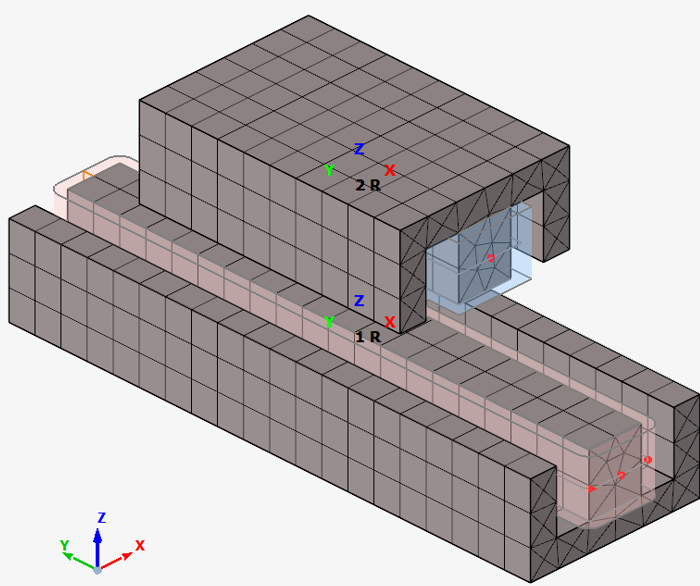
| Magnetostatic Integral (MSIM) | Wireless Power Transfer | In this tutorial, the new solution
"Magnetostatic Integral" (no need to mesh air) is used in the
modeling of electromagnetic coupler in an inductive power
transfer system. The goal is to compute the mutual-inductance between the primary coil and secondary coil under disturbances. |
 |