
Since version 2026, Flux 3D and Flux PEEC are no longer available.
Please use SimLab to create a new 3D project or to import an existing Flux 3D project.
Please use SimLab to create a new PEEC project (not possible to import an existing Flux PEEC project).
/!\ Documentation updates are in progress – some mentions of 3D may still appear.
Electric Conduction: presentation and typical example
Presentation
The Electric Conduction application enables the study of electric currents in conducting media without taking into account the associated magnetic phenomena.
Utilization
An example of Electric Conduction application used alone is the modeling of DC fuses.
Coupled with other applications (magnetostatic, thermal), it can be used for modeling rectifiers, conduction heating devices, etc.
Typical example
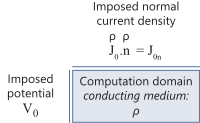
A typical example of problem treated as an Electric Conduction application is presented in the figure below.
Principal results
The principal results that can be obtained with Electric Conduction applications are:
- the space distributions of the electric potential (V), of the electric field intensity (E), of the current density(J), and of the power density (dP),
- the power dissipated (P) in a region or over the entire study domain,
By means of these quantities, it is possible to compute other useful quantities such as currents, electric resistances, etc.
3D specificity
The 3D Electric Conduction application also enables the computation of the magnetic induction created by the electric currents carrying conductors.