
SM-PM
Case without thermal solving mode
The first option of thermal setting is to run the test with only electromagnetic computation without any thermal analysis.
This option is the default one available for all the tests.
In this case, one must define the temperatures of active components to make the corresponding material physical properties updated.
For Synchronous Machines with Permanent Magnets, winding and magnet temperatures must be defined.
- Temperature of windings
Figure 1. Settings of winding temperature 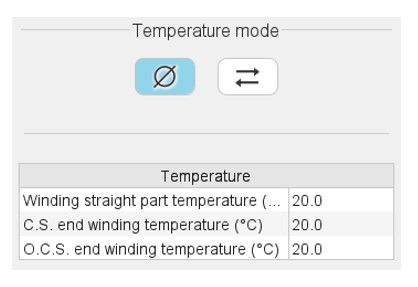
It is possible to define temperature of the three main parts of the stator winding:- Winding active length temperature (part 1)
- Connection Side (C.S.) end winding temperature (part 2)
- Opposite Connection Side (O.C.S.) end winding temperature (part 3)
Figure 2. Definition of the main parts of winding 
The resulting resistance of each part of the winding is updated according to the temperature:- Winding straight part resistance (part 1)
- Connection Side (C.S.) end winding resistance (part 2)
- Opposite Connection Side (O.C.S.) end winding resistance (part 3)
The resulting resistance for the whole winding (considering the three parts described above) is computed as phase resistance and line-line resistance.
- Temperature of magnets
The physical properties of magnets are updated considering the temperature set in this field.
The physical properties which are affected by this temperature are: the residual flux density (remanence) Br, the intrinsic coercivity (HcJ), the normal coercivity (HcB) and the resistivity.
Figure 3. Setting of magnet temperature 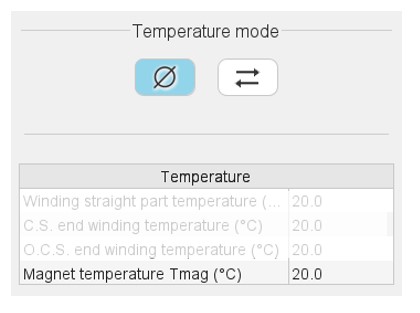
- Flow chart of the tests
Table 1. Flow chart of the tests 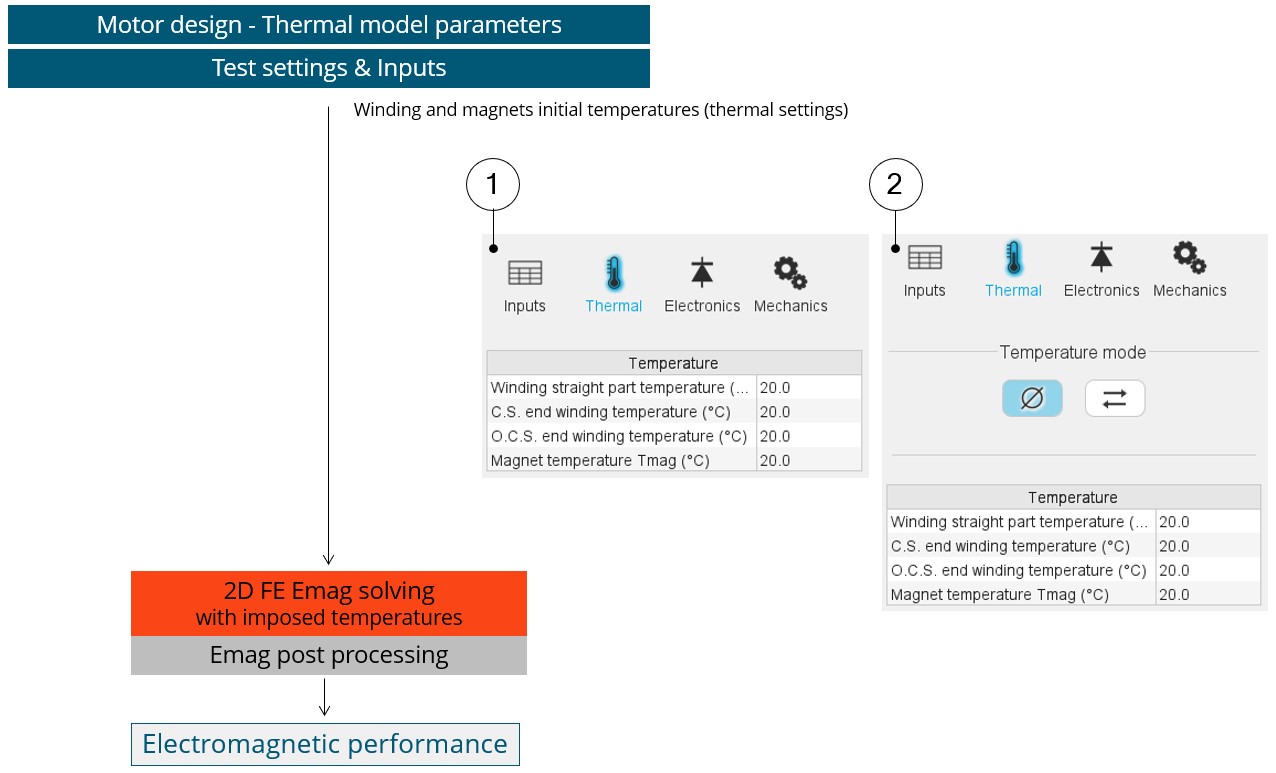
1 Default mode of thermal setting for all the tests without thermal analysis 2 Thermal settings for the tests which have a thermal analysis are available
Case with thermal solving mode
The choice of thermal solving mode is available for the test dealing with the computation of working point defined by the current, control angle and speed. These solving modes involve interactions between electromagnetic and thermal computations.
- Thermal settings to initialize the test
For both scenarios, here is the list of thermal settings needed to initialize the test.
Table 2. List of thermal settings 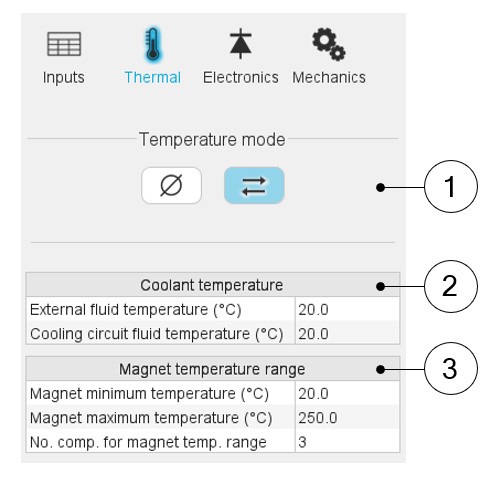
1 Dialog box to define thermal settings. Iterative solving mode is selecting. 2 With the second solving mode (i.e. with the iterative thermal solving mode) the coolant temperatures must be defined. Definition of coolant temperatures (if there is a cooling circuit) to be considered: - External fluid temperature (1)
- Cooling circuit fluid temperature (2)
3 Temperature of magnets to be considered must be defined: - Range of temperatures between the minimum and the maximum ones
- Number of computations to be considered within
the previous range of temperatures.
The minimum allowed value is 2. Higher is the number, better is the quality of results, but higher is the computation time. The default number of computations is 3. It is a good compromise
Note: (1) The external fluid temperature corresponds to the temperature of the fluid surrounding the machine. It is also considered as the temperature at the “infinite” for the computation of radiation from the frame to the infinite.Note: (2) The cooling circuit fluid inlet temperature is proposed only when a cooling circuit has been added by the user in the design environment. - Flow chart of thermal solving mode – “Iterative” process
- Flow chart of the thermal solving mode test with iterative
process.
Table 3. Definition of the temperature list of magnets (see the list in the previous section) and working point inputs 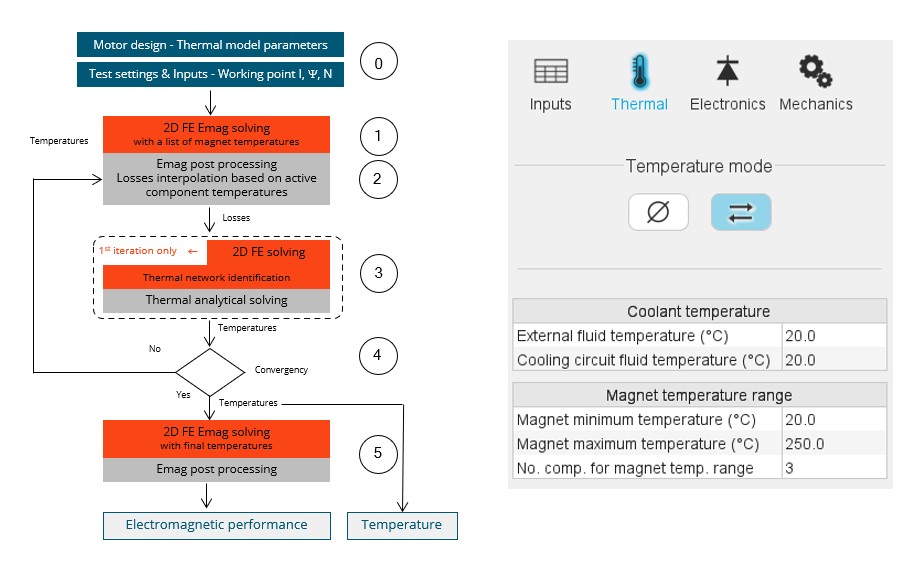
1 Electromagnetic solving (Finite Element computation) for a list of magnet temperatures between the min. and max. values given in the setting. 2 Loss terms are interpolation regarding to the magnet temperature given by the thermal computation in the next step. 3 Based on the speed and losses computed in the electromagnetic working point for the first magnet temperature, the thermal characterization is performed to define the temperature distribution inside the machine. The materials physical properties corresponding to the machine active components are then updated.
4 Iterative process = loop between the interpolation of losses and the thermal computations until the convergence on the temperature is reached (See below where the convergency criteria can be adjusted, if needed). 5 A last electromagnetic solving (Finite Element computation) with final set of temperatures is performed once the convergence on the temperature is reached (1). Electromagnetic performance and chart of temperatures are computed and displayed.
The test outputs are illustrated in the sections dedicated to the considered tests.
Note: (1) The temperatures which are considered for computing the final machine performance (step 4 in the previous flow chart) can be read in the table dealing with “Winding and Magnet characteristics” of the test configuration at the beginning of result report. The temperatures are also displayed in the temperature chart and table after the electromagnetic results. - Thermal characterization in steady state – Flow chart
This section illustrates how the thermal characterization is performed to define the temperature distribution inside the machine from a set of losses and a working point speed
This process corresponds to what is performed to make the thermal characterization of the machine in the test Characterization / Thermal / Steady state
It corresponds to the second step of the previous general flow chart.
Figure 4. Thermal test – Internal process flowchart 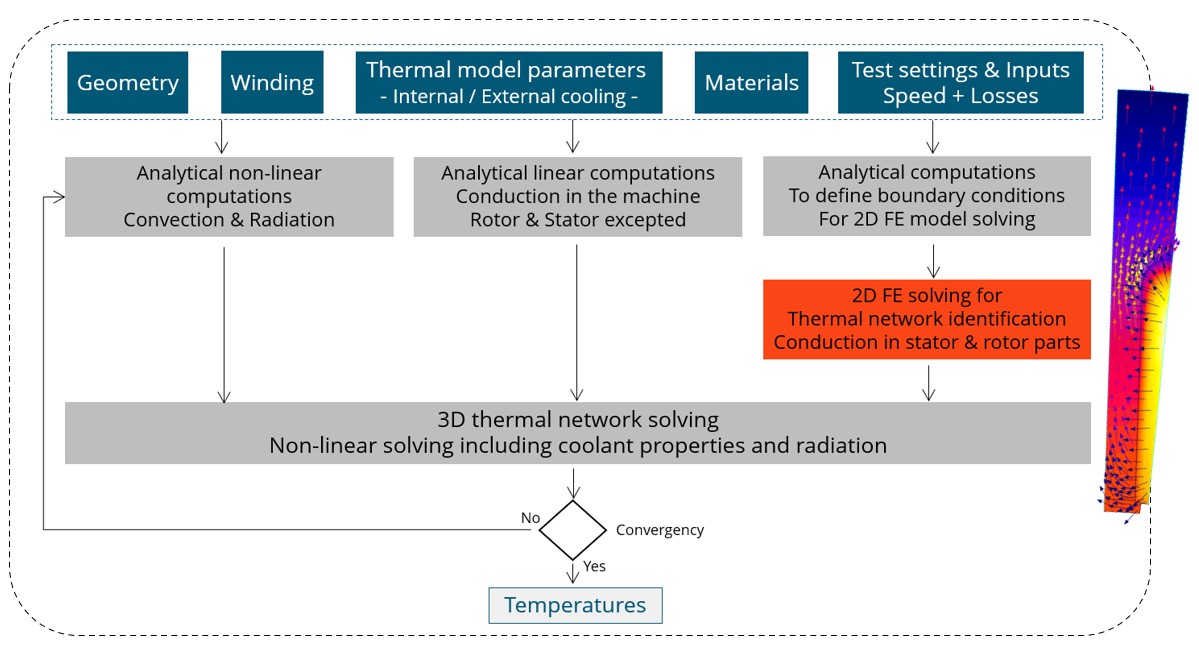
The inputs of the internal process are the parameters of: Geometry, Winding, Internal cooling, External cooling, Materials, Test settings and inputs.Note: A 2D Finite Element model is solved to identify a thermal network which corresponds accurately to any kind of rotor or stator parts, including user parts.Then, the resulting network is extended with analytical computations to consider the 3D effect of the geometry.
The solving allows to get and to display the whole chart of temperatures of the machines.
- Iterative process – Adjustment of the convergence
criteria
Table 4. Iterative process – Adjustment of the convergence criteria 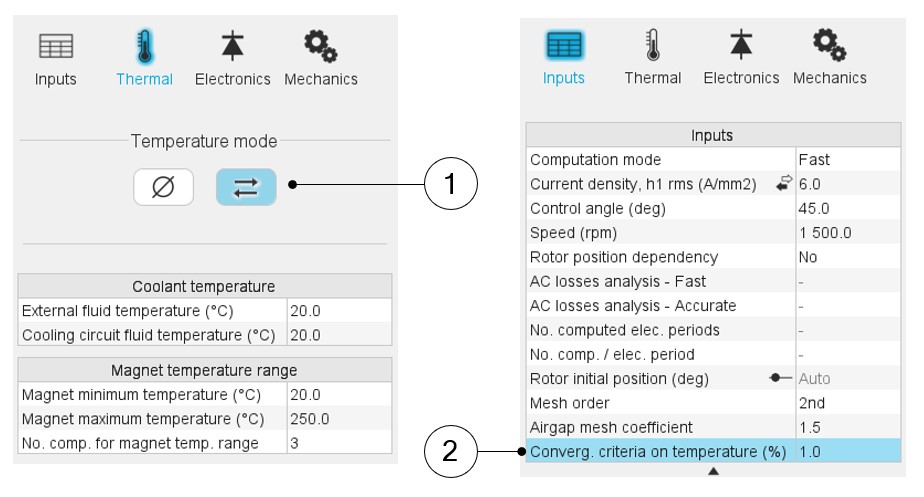
1 Selection of the thermal solving Iterative process in thermal settings 2 Convergence criteria can be adjusted for reaching steady state behavior. The iterative solving is stopped once the temperature variation in the machine between two iterations is lower than the convergence criteria. A percentage close to zero gives more accurate results but takes a higher computation time. A high percentage can make the convergence shorter but decreases the accuracy of the results.
- Flow chart of the thermal solving mode test with iterative
process.
Limitation - Advice for use
Please refer to Advice for use.