
Inputs
Standard inputs ––––--
Speed
The speed of the machine to be considered.
Set of losses
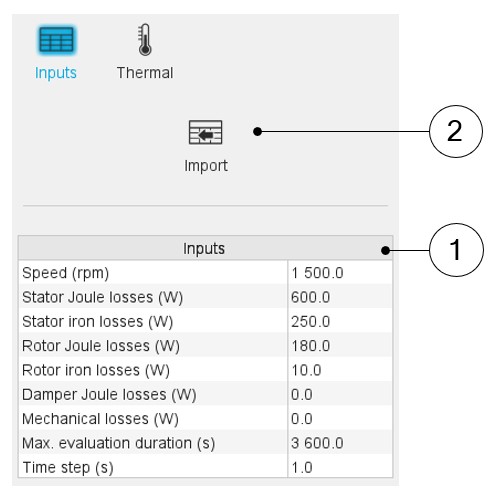
The losses to be defined are the following ones:
- Stator Joule losses – Copper losses occurring in the stator windings.
- Stator iron losses – Core losses generated in the stator laminations.
- Rotor Joule losses – Copper losses in the rotor field winding.
- Rotor iron losses – Core losses generated in the rotor laminations.
- Damper Joule losses – Copper losses in the damper circuit.
- Mechanical losses – Losses due to mechanical friction, primarily within the bearings.
Time definition
The time during which the test is performed, defined by:
- Maximum evaluation duration
- Time step
Description
The set of inputs can be imported from another test already performed in Motor Factory Test environment.
It can be current results or saved test results.
Then the duration of the evaluation and the time step must be defined.
 |
|
|---|---|
| 1 | Fill in the table to define the speed, all the losses to be considered, the max evaluation duration and the time step. |
| 2 | Click on the button “import” to import inputs corresponding to a solved test. All existing data of the selected test will be imported into the inputs of the thermal characterization. The data which does not exist in the outputs of the selected test are set to 0. |
 |
|
|---|---|
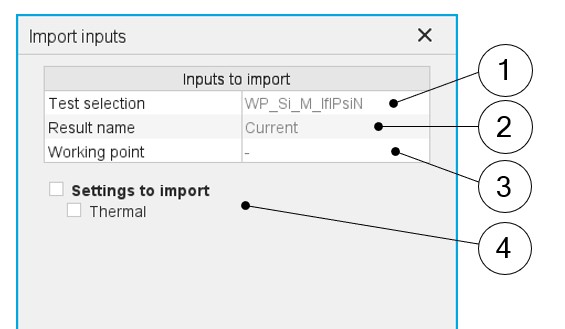
| 1 | Selection of the test. Only solved tests are available in the drop-down list. |
| 2 | Current tests as well as saved tests can be selected. |
| 3 | When several working points are computed in the selected test, each of them can be selected to consider the corresponding losses. |
| 4 | The thermal settings of the referent test can be imported as well |
Note: The imported data are the output data directly shown in the
considered solved test. For some tests, some values are not defined (like for
instance the Joule magnet losses or rotor iron losses). In that case, the
corresponding input in transient thermal test will remain at the value existing
before the import.
Advanced input ––––--
There are no advanced inputs required for this test.
Advice for use
Note: The resistance network identification of a machine is
always done without any skew angle. This can bring some inaccuracy in the
results for highly skewed machines.