
Inputs
Standard inputs ––––--
Speed
The speed of the machine is to be considered.
Set of losses
The losses to be defined are the following:
- Stator Joule losses
- Stator iron losses
- Magnet losses
- Rotor iron losses
- Mechanical losses
Max. allowed deviation
The maximum temperature deviation allowed to consider the optimization algorithm has converged. All the final temperatures must have a lower deviation.
Input import
The set of inputs concerning speed and losses, can be imported from another test already performed in Motor Factory Test environment.
It can be current results or saved test results.
If the referent test has been performed with the thermal computations, the resulting temperatures can also be imported.
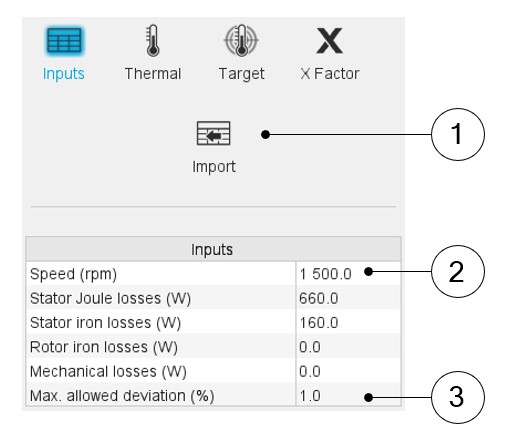
See the illustration below.
 |
|
|---|---|
| 1 | Fill in the table to define the speed, all the losses to be considered, the maximum evaluation duration, and the time step. |
| 2 | Click on the button “import” to import inputs corresponding to a solved test. All existing data from the selected test will be imported into the inputs of the thermal characterization. The data that does not exist in the outputs of the selected test is set to 0. |
| 3 | Choose what must be the maximum temperature deviation that will allow us to consider that the optimization algorithm has converged. |
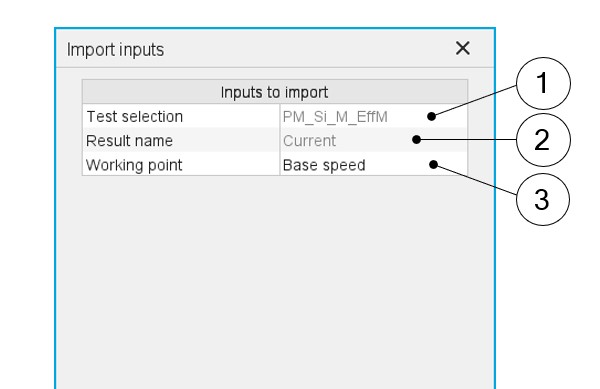 |
|
|---|---|
| 1 | Selection of the test. Only solved tests are available in the drop-down list. |
| 2 | Current tests as well as saved tests can be selected. |
| 3 | When several working points are computed in the selected test, each of them can be selected to consider the corresponding losses and speed. |
Note: The imported data are the output data directly shown in the
considered solved test. For some tests, some values are not defined (like for
instance the Joule magnet losses or rotor iron losses). In that case, the
corresponding input in the transient thermal test will remain at the value existing
before the import.
Note: If the thermal results from the imported test have been
obtained with the current internal thermal scheme, then all the target temperatures
in the dialog box will be affected by the target temperature. However, if the
temperatures are imported from a test solved using a previous version of the thermal
scheme (with less thermal nodes), then the new thermal nodes (which did not exist in
the previous thermal scheme) will remain in the Auto mode.
Advanced inputs ––––--
There are no advanced inputs required for this test.
Advice for use
Note: The resistance network identification of a machine is
always done without any skew angle. This can cause some inaccuracy in the
results for highly skewed machines.