
T(Slip)
Positioning and objective
The aim of the test “Performance Mapping – Sine wave – Motor – T(Slip)” is to characterize the behavior of the machine when operating over a speed range corresponding to a targeted operating mode (“Motor”, “Generator”, “Brake”, “Motor & Generator”, “Motor & Brake” and “Full”). This also corresponds with the operating magnitude of line-line voltage (U) and power supply frequency input values (f).
Hence, these inputs are enough to define a T(Slip) curve and to get additional curves defining all electromagnetic quantities.
Note: In addition, the input “user working point - slip” allows to target a specific working point to get all the corresponding electromagnetic quantities summarized in a table.
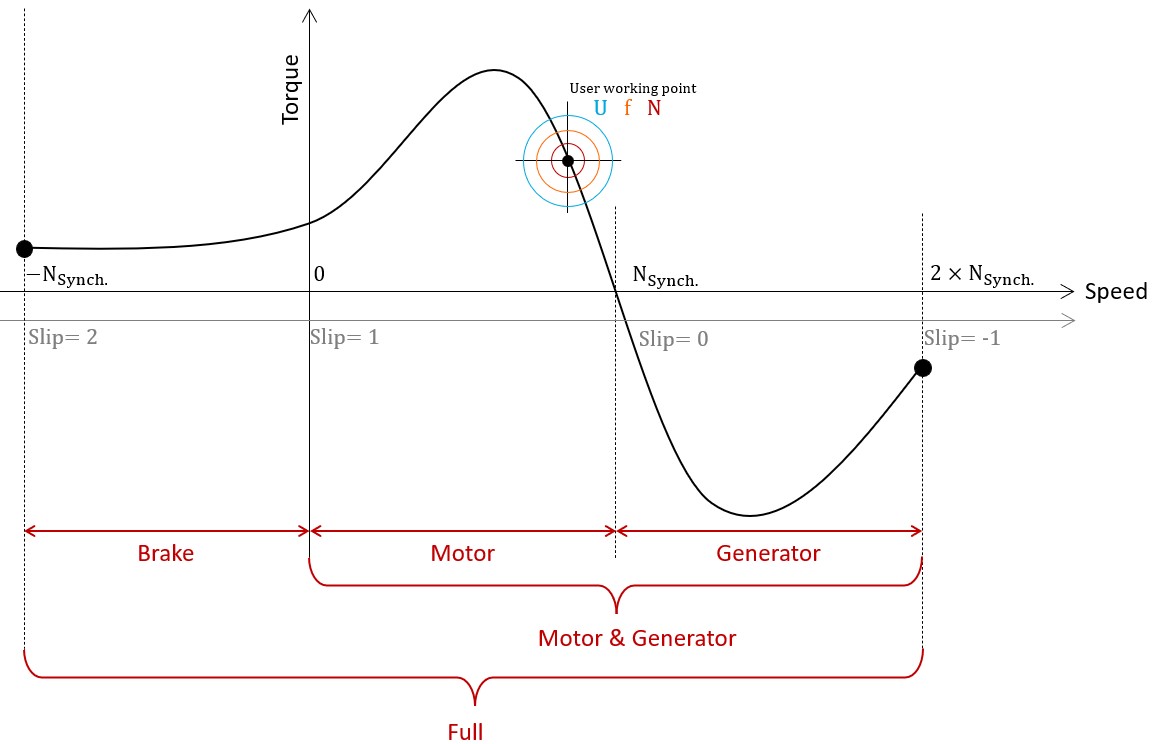
The results of this test give an overview of the electromagnetic behavior of the machine considering its topology.
For the targeted user working point, in addition to the general data, machine constants, flux in airgap and the magnetic flux density in every regions of the machine’s magnetic circuit are also computed for evaluating the design of the machine.
It also gives the capability to make comparisons between results got from the measurements and those got with the Altair® FluxMotor.
The following table helps to classify the test “Performance mapping – Sine wave – Motor – T(Slip)”.
| Family | Performance mapping |
|---|---|
| Package | Sine wave |
| Convention | Motor |
| Test | T(Slip) |
Inputs
For more details, please refer to Inputs.
Thermal
For more details, please refer to Thermal.
Electronics
For more details, please refer to Electronics.
Mechanics
For more details, please refer to Mechanics.