
Maps - Vector
Positioning and objective
The aim of the “Characterization - Model - Motor - Maps” test is to obtain maps along the tow dimensions, Jd-Jq, for characterization of a 3-Phase induction machines.
The identification of the maps is done to obtain a rotor field-oriented control (R-FOC), i.e. to model an induction machine with the same vector field reference as for a synchronous machine. In other words, the behaviour of the machine is computed with the rotor flux aligned along the d-axis (rotor flux in the q-axis equal to zero). From this point of view, we can say that the FluxMotor test maps for all major machine types are based on the same modelling principles, we speak about "unified vector model".
Maps computed in Jd-Jq, plan allow for predicting the behavior of the electrical rotating machine at a system level.
In this test, engineers will find a system integrator and / or control-command tool adapted to their needs and able to provide accurate maps ready to be used in system simulation software like PSIM or Activate. As explained earlier, one of the great advantages of this test is that it allows a vector model of an induction machine to be created, as for a synchronous machine, and then vector control to be applied using the same principles.
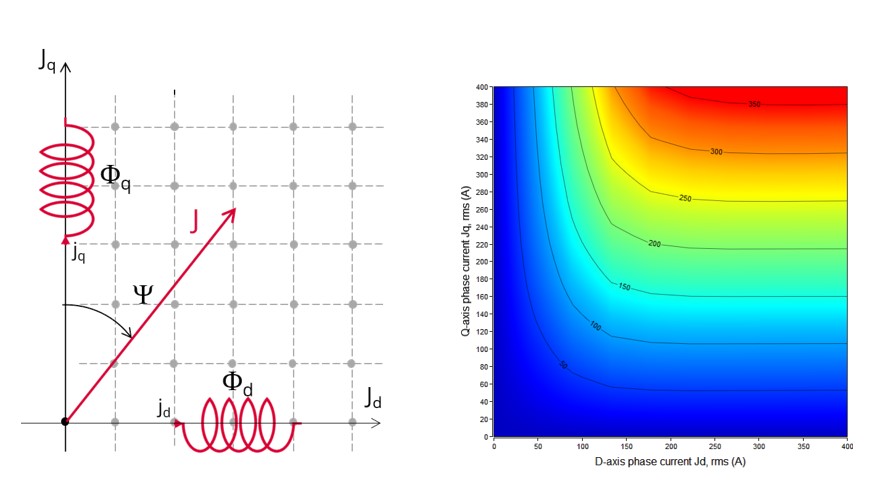
The performance of the machine in steady state can be deduced from the results obtained in this test in association with the drive and control mode to be considered.
The following table helps to classify the test:
| Family | Characterization |
|---|---|
| Package | Model |
| Convention | Motor |
| Test | maps |
Subsections
Inputs
For more details, please refer to Inputs.
Thermal
For more details, please refer to Thermal.
Electronics
For more details, please refer to Electronics.
Mechanics
For more details, please refer to Mechanics.