Rattle evaluation is based on the assessment of relative displacement between two
parts along the defined E-Line. The relative displacement is compared to
the gap and tolerance values defined during the pre-processing workflow.
The automatic assessment can be used to understand the rattle phenomena using the
following:
Relative displacement magnitude and in local Z-direction.
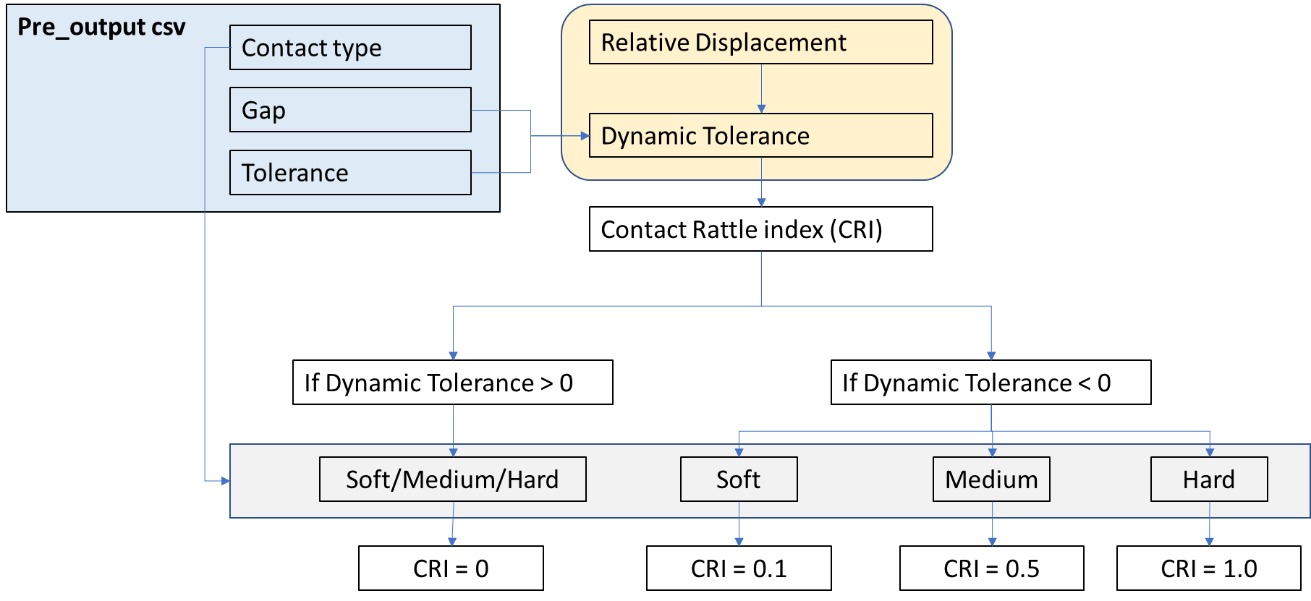
Dynamic Tolerance is defined as: Gap [mm] - Tolerance [mm] -
Relative Dsiplacement in Z.
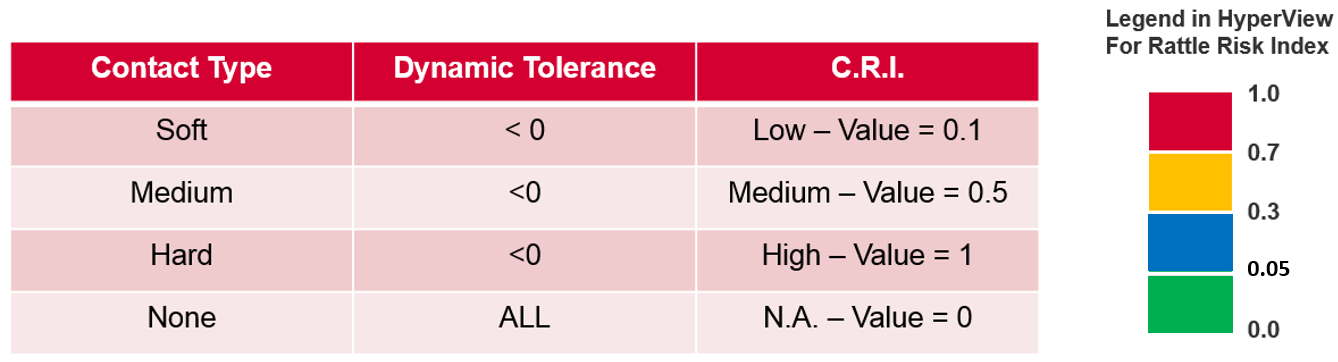
In addition, SnRD proposes an unit-less Contact Rattle
Index (CRI) coupled to the material pair along the rattle E-Line.
Named Contact Type, this criterion is based on material stiffness values.
Contact Types
Soft: materials such as foam, leather and rubber- default Youngs(E) Modulus
< 500 MPa
Hard: hard plastics, metals, glass materials- E-modulus > 10000 MPa
Note: The range of Young Modulus is fully customizable in SnRD Post-Processing. From the rattle evaluation, you can exclude interfaces
where material, like fabrics, are applied in the real world, while not modeled
in the FE model. The evaluation process based for the CRI is shown in Figure 1.Figure 1. Figure 2. Contact Risk Index Matrix