
Working point I - U
Positioning and objective
The aim of the test “Characterization - Datasheet – Motor – I, U” is to characterize the behavior of the machine when operating at the working point that is located at the base speed point.
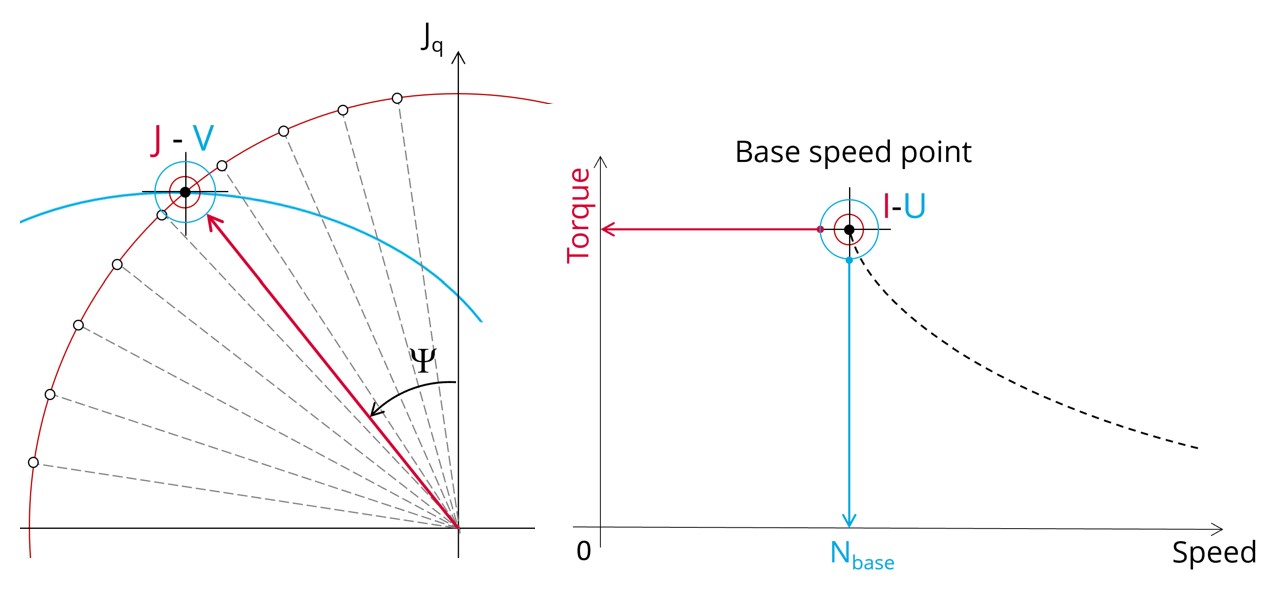
This test gives an overview of the electromagnetic analysis of the motor considering the machine topology, the maximum allowed supplied line-line voltage and line current.
For this working point, general data of the machine, like machine constants, power balance and magnet behavior are computed and displayed. The magnetic flux density is also computed in every part of the machine to evaluate the design.
The test results also include all the necessary constants to build the equivalent model of the machine and to simulate the behavior of the machine in its electrical environment. In the results, a set of inductances is computed (unsaturated and at the base speed point).
The ripple torque at the base speed point is computed.
An overview of the machine performance at no-load is also given in this test.
The following table helps to classify the test “Characterization – Datasheet – Motor – I, U”.
| Family | Characterization |
|---|---|
| Package | Datasheet |
| Convention | Motor |
| Test | I, U |