Cogging
Positioning and objective
The aim of the test “Characterization - Open circuit – Motor & Generator - Cogging torque” is to get the characteristics of the cogging torque of the machine.
Thanks to this test it is possible to evaluate the impact of the machine topology (slots and magnets – number and dimensions) on the cogging torque characteristics (magnitude and period).
The following table helps to classify the test “Open circuit - Cogging torque”.
| Family | Characterization |
|---|---|
| Package | Open circuit |
| Convention | Motor & Generator |
| Test | Cogging Torque |
Advice for use
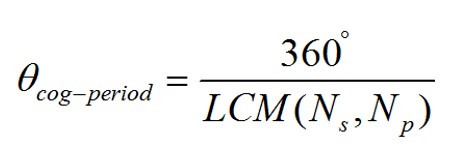
The cogging torque period depends on the number of slots (NS) and the number of poles (NP).
It is given by the dividing 360°, circular mechanical degree in space, by the least common multiple of number of stator slots (NS) and number of rotor poles (NP).
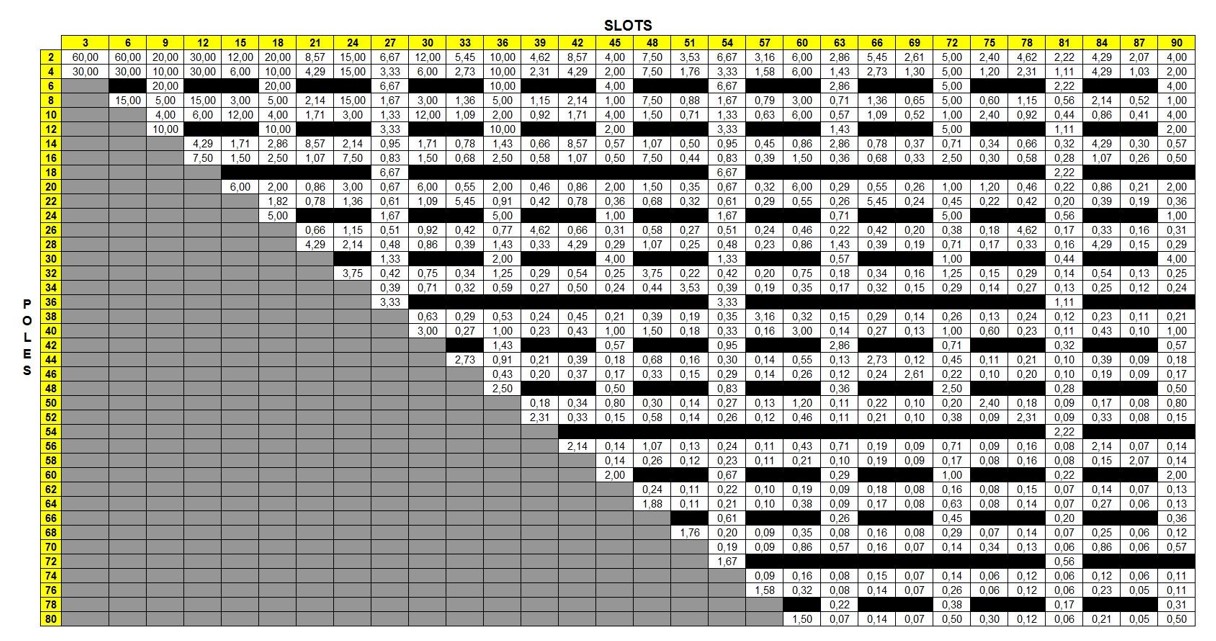
In general, with increasing number of slots and poles, cogging torque period decreases as shown in the following table.
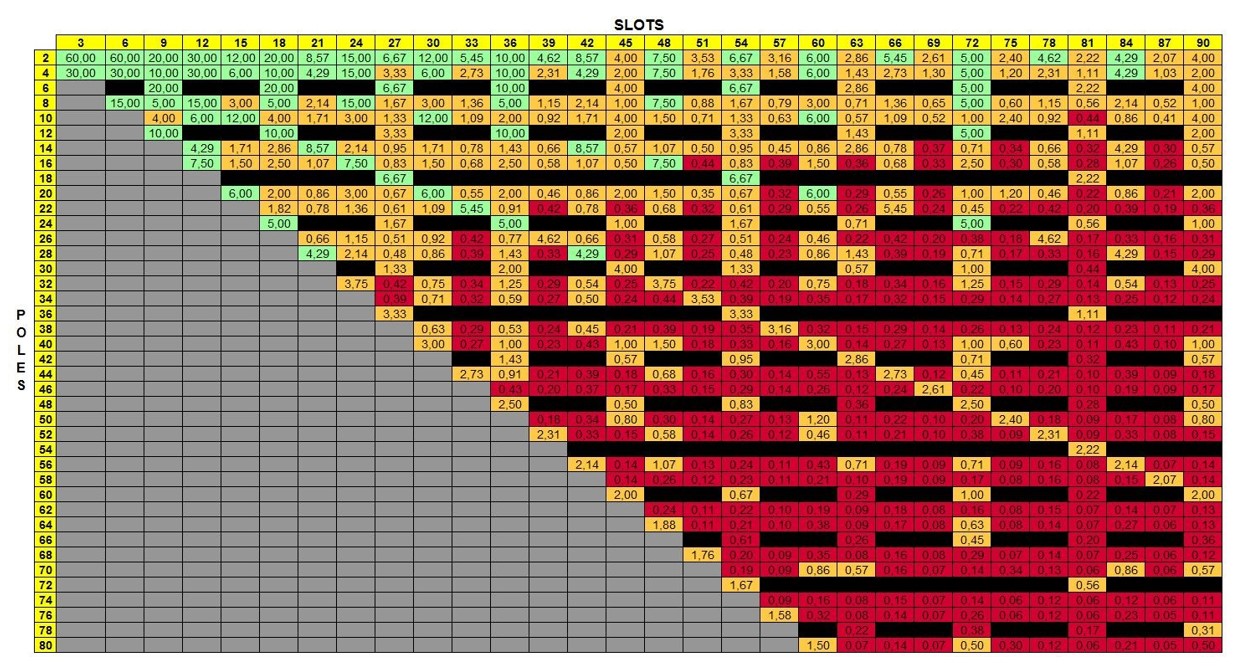
In the case of a very small cogging torque period, consideration of the airgap length is also relatively important.
In these conditions it is not possible to get good results because the numerical error induced by the mesh (meshing noise) has the same magnitude order than the cogging torque.
Dedicated mesh methods are needed for such situations but are not yet implemented in FluxMotor.
In those cases, the advanced solution is to export the model to Altair Flux and to adapt the mesh manually to reach the expected accuracy.
For information, the following table gives a general idea of easy computations (green cells), difficult ones (orange cells) and in some instances impossible ones (red cells) in FluxMotor.
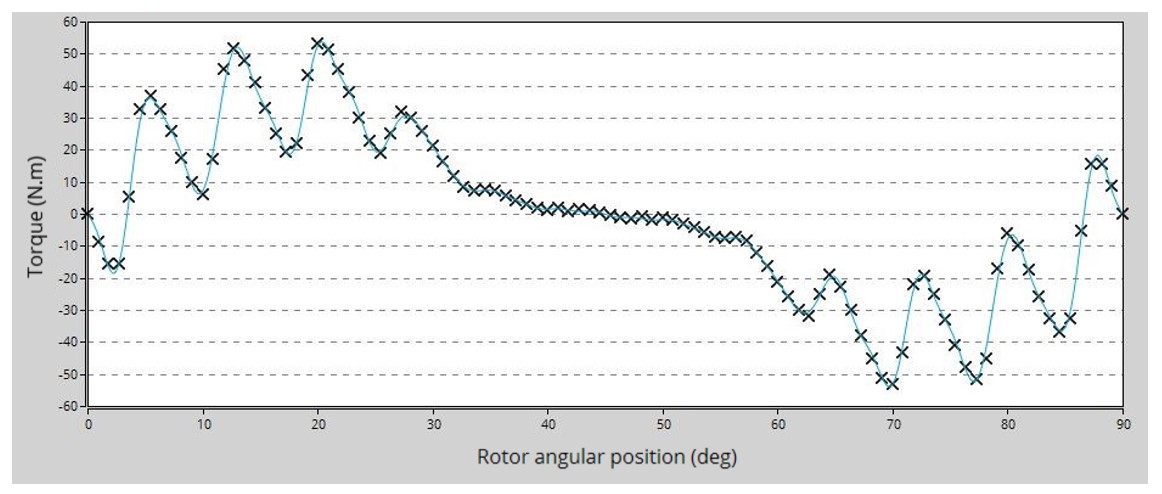
To be noted that in case of square shape lamination, the analysis of the cogging torque will be done at least over 90 mechanical degrees (see the following example).