
/FAIL/LEMAITRE
Block Format Keyword A stress triaxiality-based failure model dedicated to ductile failure. It is based on plastic strain evolution, and the computed damage variable generates a softening of the stress tensor.
This failure model can be used for shell and solid elements and is compatible with all elasto-plastic materials.
Format
| (1) | (2) | (3) | (4) | (5) | (6) | (7) | (8) | (9) | (10) |
|---|---|---|---|---|---|---|---|---|---|
| /FAIL/LEMAITRE/mat_ID/unit_ID | |||||||||
| FAILIP | P_thickfail | ||||||||
| (1) | (2) | (3) | (4) | (5) | (6) | (7) | (8) | (9) | (10) |
|---|---|---|---|---|---|---|---|---|---|
| fail_ID |
Definition
| Field | Contents | SI Unit Example |
|---|---|---|
| mat_ID | Material identifier. (Integer, maximum 10 digits) |
|
| unit_ID | (Optional) Unit
identifier. (Integer, maximum 10 digits) |
|
| Plastic strain value triggering the
damage evolution. Default = 1.0E30 (Real) |
||
| Strain energy release
rate. Default = 1.0E30 (Real) |
||
| Critical damage value to trigger
element deletion. Default = 1.0 (Real) |
||
| FAILIP | Number of failed integration points
prior to solid element deletion. Default = 1 |
|
| P_thickfail | Fraction of failed thickness for
shell element deletion. -1.0 ≤ P_thickfail ≤ 0 Fraction of failed integration point through thickness. 0.0 ≤ P_thickfail ≤ 1.0 Fraction of failed thickness. Default = 1.0 (Real) |
|
| fail_ID | (Optional) Failure criteria
identifier. (Integer, maximum 10 digits) |
Example
#RADIOSS STARTER
#---1----|----2----|----3----|----4----|----5----|----6----|----7----|----8----|----9----|---10----|
/UNIT/1
                  Mg                  mm                   s
/FAIL/LEMAITRE/25
#              EPS_D                 S_D                  DC              FAILIP         Pthick_fail
                 .27                0.05                  1.                   1                 0.5
#  fail_ID
      1234
#---1----|----2----|----3----|----4----|----5----|----6----|----7----|----8----|----9----|---10----|
Comments
- The LEMAITRE failure criterion is based on the damage coupled model
proposed by Lemaitre & Chaboche and later Lemaitre & Desmorat. It
considers the continuum damage mechanics framework introduced by Kachanov.
To describe this framework let us consider a Representative Volume
Elementary (RVE) of a section
to which a normal load
is applied.
Figure 1. 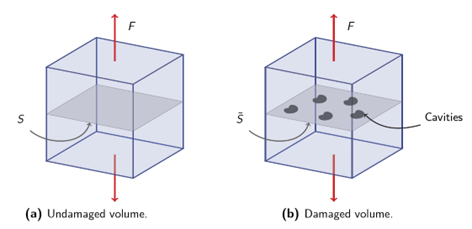
The stress in the undamaged volume (a) is then:
If the same elementary volume is damaged (b), the remaining effective surface decreases and the damaged surface occupied by cavities increases. The damage variable is then defined as the ratio between the damaged and the initially sound surface.
This variable evolves between 0 (no damage) and 1 for a complete RVE failure. In this case, the cavities are occupying the entire initial section of the elementary volume. The stress in the damaged volume can be expressed by:
One can then differentiate the effective stress of the elasto-plastic section denoted and the equivalent damaged stress of the entire finite element section denoted . The stress in the element then decreases as the damage variable increases, until complete failure, in which the cavities occupy the entire element section ( ).
- The proposed LEMAITRE damage model considers an evolution of the
damage variable governed by:
Where, is a variable based on thermodynamic theory so-called elastic energy release rate, computed with:
Using some assumptions, this variable can be rewritten as:
Where,- Effective von Mises stress
- Material Young's modulus
- Stress triaxiality dependent coefficient that is obtained
with:
According to this equation, you can see that the damage rate is higher at large stress triaxiality, implying a less ductile behavior with the increasing triaxiality.
It is worth noting that the damage variable only evolves under tensile loading condition ( ), as ductile fracture under compression is less likely.
- This failure model has three parameters to be set up:
- Plastic strain value threshold to trigger the damage variable evolution
- Fracture elastic energy release rate. If an accurate identification of this parameter is not performed, it is recommended to use with the initial yield stress.
- The critical damage value at which element / integration point is deleted, and stress tensor is set to zero (even if the evolution of the damage variable has not been completed).
- This damage model is compatible with /NONLOCAL/MAT to obtain regularized and mesh independent results.
- The fail_ID is used with /STATE/BRICK/FAIL and /INIBRI/FAIL. There is no default value. If the line is blank, no value is output for failure model variables in the /INIBRI/FAIL (written in the .sta file with /STATE/BRICK/FAIL option). It can also be used for some specific failure output /H3D/ELEM/FAILURE.